
Astronomers using the Atacama Large Millimeter/submillimeter Array (ALMA) have finally found clear evidence that the supermassive black hole at the center of the Milky Way, Sagittarius A*(Sgr A*), is blowing a hot cosmic wind – something scientists have been hunting for over 50 years.
Recent News
AUI Announces 2026 Scholarship Recipients
Ten high school students have been awarded for academic achievement, community involvement and leadership skills.
NSF NRAO Leads Future of U.S. Radio Astronomy with First Light from Next Generation Very Large Array Prototype
The proposed array’s design will improve on the sensitivity and spatial resolution—with 10 times the effective collecting area and resolution—over the current NSF VLA and the Atacama Large Millimeter/submillimeter Array at the same wavelengths.
NSF National Radio Astronomy Observatory Collaborates with RIX Industries
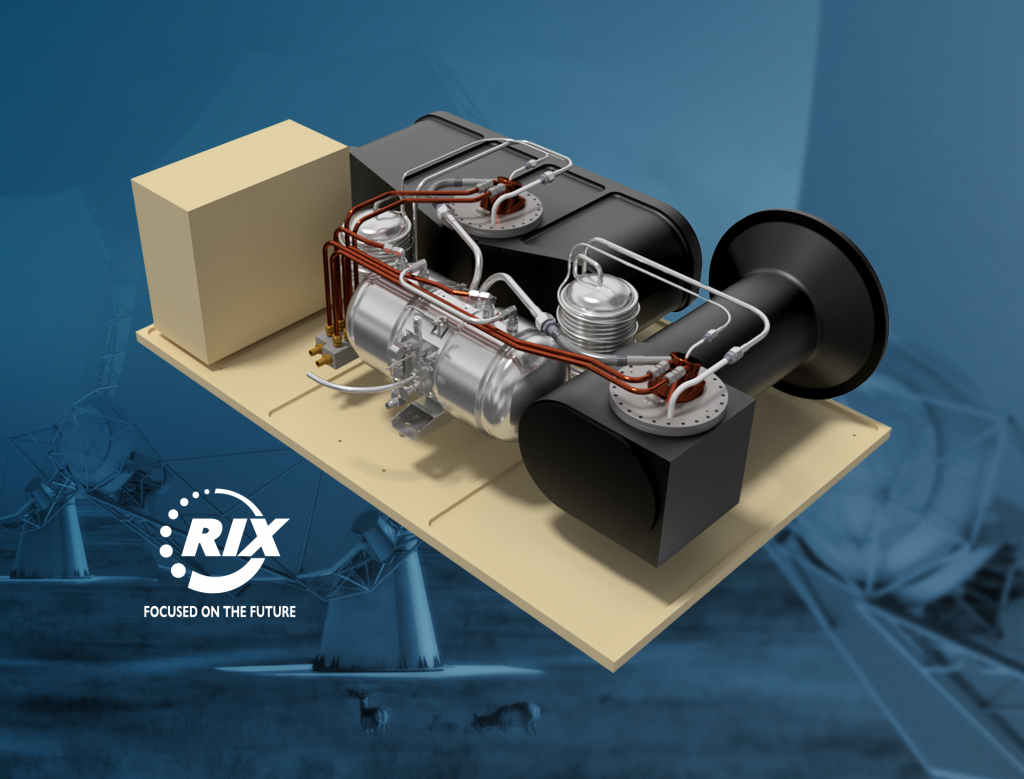
Artist interpretation/Model of the Cryogenic Cooler. Credit: J. Hellerman U.S. National Science Foundation/NSF National Radio Astronomy Observatory, RIX Industries
The U.S. National Science Foundation National Radio Astronomy Observatory (NSF NRAO) is excited to announce a collaboration with RIX Industries to explore innovative cryogenic cooling solutions for the Next Generation Very Large Array (ngVLA), a transformative radio astronomy project poised to redefine our understanding of the universe.
The ngVLA, envisioned as an array of up to 263 antennas spread across North America, will significantly surpass the capabilities of the current U.S. National Science Foundation Very Large Array (NSF VLA). To achieve its ambitious scientific goals while maintaining operational efficiency, NSF NRAO is prioritizing advancements in cryogenic cooling systems, which are critical for maintaining optimal performance of sensitive radio receivers.
Cryogenic cooling systems currently represent a significant portion of the operating costs for the NSF VLA. The ngVLA aims to reduce these costs while expanding the telescope’s capacity nearly tenfold. To address this challenge, NSF NRAO partnered with RIX Industries to investigate the feasibility of adapting their Thermoacoustic Stirling-cycle Cryocooler (TASC) technology to the ngVLA’s unique requirements.
The partnership began with a feasibility study funded by NSF NRAO to evaluate whether RIX’s advanced cryocooler technology could meet stringent specifications, including cooling capacities of 4 watts at 20 K and 15 watts at 80 K, while consuming less than 2,700 watts of power per unit. The study demonstrated promising results, indicating that RIX’s TASC technology could be adapted for two-stage cooling systems required by the ngVLA.
Following the feasibility study, NSF NRAO and RIX conducted a design study involving detailed computer simulations and mechanical designs. These efforts confirmed that RIX’s cryocooler technology could meet performance requirements while offering advantages such as reduced maintenance, improved reliability, and 50% reduction in power consumption compared to traditional Gifford-McMahon systems.
Despite funding limitations for prototype fabrication, RIX Industries committed to advancing the project using their internal research and development resources. This decision underscores the potential impact of this collaboration on both scientific discovery and commercial cryogenic applications.
RIX’s expertise in thermoacoustic cooling technologies—used in applications ranging from oxygen liquefaction aboard Navy carriers to terrestrial and space scientific instrumentation cooling —positions them as an ideal partner for developing cutting-edge solutions tailored to the ngVLA’s needs. Their cryocoolers eliminate cold moving parts, reducing maintenance demands and enhancing system reliability over decades-long operational lifespans.
As NSF NRAO continues to explore funding opportunities for full-scale prototype development, the collaboration with RIX Industries exemplifies how partnerships between science institutions and industry can drive technological innovation. “Our collaboration with RIX Industries is an outstanding example of collaboration between the observatory and a US industrial partner to achieve important reductions in environmental impacts and operational costs through advanced cryogenic technology for the ngVLA,” commented Rob Selina, ngVLA Project Engineer. The successful integration of advanced cryogenic systems into the ngVLA will not only support groundbreaking astronomical discoveries but also set new standards for efficiency and sustainability in large-scale scientific infrastructure.
About NRAO
The National Radio Astronomy Observatory is a facility of the U.S. National Science Foundation, operated under cooperative agreement by Associated Universities, Inc.
About RIX Industries
RIX Industries, founded in 1878, specializes in the engineering and manufacturing of advanced gas generation, high-pressure compression, and cryogenic cooling systems. Designed for mission-critical performance, RIX technologies support demanding applications across aerospace, energy, marine, industrial, and medical sectors. For more information, visit www.rixindustries.com
This news article was originally published on the NRAO website on May 15, 2025.


Recent News
Milky Way’s Black Hole Finally Caught ‘Breathing’
Astronomers using the Atacama Large Millimeter/submillimeter Array (ALMA) have finally found clear evidence that the supermassive black hole at the center of the Milky Way, Sagittarius A*(Sgr A*), is blowing a hot cosmic wind – something scientists have been hunting for over 50 years.
AUI Announces 2026 Scholarship Recipients
Ten high school students have been awarded for academic achievement, community involvement and leadership skills.
NSF NRAO Leads Future of U.S. Radio Astronomy with First Light from Next Generation Very Large Array Prototype
The proposed array’s design will improve on the sensitivity and spatial resolution—with 10 times the effective collecting area and resolution—over the current NSF VLA and the Atacama Large Millimeter/submillimeter Array at the same wavelengths.