
Meet Sonia Duffau, head of Education and Public Outreach (EPO) for the U.S. National Radio Astronomy Observatory in Chile.
Recent News
Young Stars Shape the Fate of Galaxies
A team of astronomers found that in typical galaxies, pressure from ionized gas generated by newly formed stars drives the expansion of star-forming regions. However, whether these regions continue to grow or stall depends strongly on their surrounding environment.
NSF VLA and ALMA Reveal Hidden “Ring Factories” of Giant Star Clusters in Nearby Galaxies
Astronomers have used U.S. National Science Foundation National Radio Astronomy Observatory (NSF NRAO) radio telescopes in Chile and New Mexico to peer through cosmic smoke and haze, building one of the clearest pictures yet of how giant clusters of young stars are born in the hearts of nearby galaxies.
ALMA Reveals Planets Can Form Under Harsh Radiation
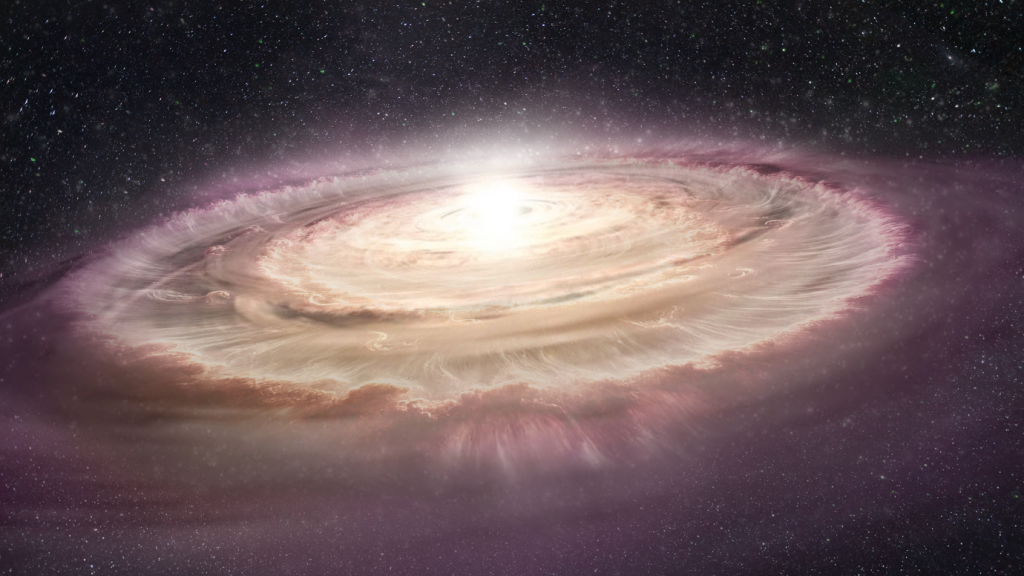
Credit: NSF/AUI/NSF NRAO/S.Dagnello
International team of astronomers reveal high-resolution look at protoplanetary disks in extreme environment
New observations from the Atacama Large Millimeter/submillimeter Array (ALMA) suggest that planet formation can occur even in harsh stellar environments previously thought to be inhospitable.
An international team of astronomers used ALMA to capture high-resolution images of eight protoplanetary disks in the Sigma Orionis cluster, which is irradiated by intense ultraviolet light from a massive nearby star. To their surprise, they found evidence of gaps and rings in most of the disks—structures commonly associated with the formation of giant planets, like Jupiter.
“We expected the high levels of radiation in this cluster to inhibit planet formation in the outer regions of these disks,” said lead author Jane Huang. “But instead, we’re seeing signs that planets may be forming at distances of tens of astronomical units from their stars, similar to what we’ve observed in less harsh environments.”
Previous studies had focused on disks in regions with low ultraviolet radiation. This new research provides the ALMA’s highest resolution look at disks in a more extreme environment. “These observations suggest that the processes driving planet formation are quite robust and can operate even under challenging circumstances,” Huang noted. “This gives us more confidence that planets may be forming in even more places throughout the galaxy, even in regions we previously thought were too harsh.”
The findings have implications for understanding the formation of our own Solar System, which likely evolved in a similarly high-radiation environment. They also motivate future studies of disks in even more extreme stellar neighborhoods.
The research team used ALMA’s most extended antenna configuration to obtain unprecedented detail in their disk images, achieving a resolution of about 8 astronomical units. This allowed them to resolve multiple distinct gaps and rings in several of the disks. While the exact nature of these disk structures is still debated, they are thought to be either conducive to planet formation or a consequence of interactions between forming planets and the disk material.
This study demonstrates the power of ALMA to probe planet formation in diverse environments across the galaxy. As astronomers build a more complete picture of how planets form under different conditions, they come closer to understanding the origins of Earth and the prevalence of planets around other stars.
This research was published in the Astrophysical Journal.
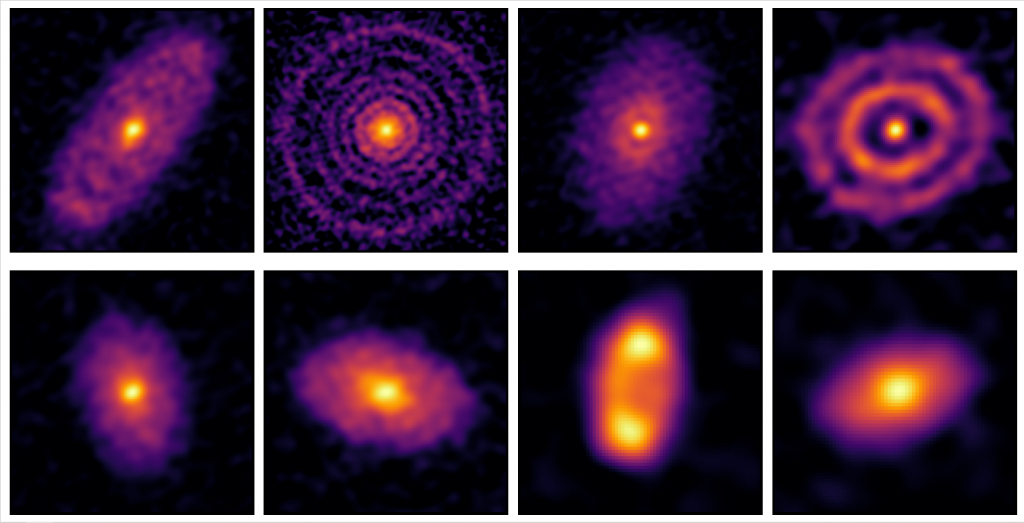
Images captured by ALMA’s most extended antenna configuration reveal surprisingly rich disk structures in the sigma Ori cluster.
About ALMA
The Atacama Large Millimeter/submillimeter Array (ALMA), an international astronomy facility, is a partnership of ESO, the U.S. National Science Foundation (NSF) and the National Institutes of Natural Sciences (NINS) of Japan in cooperation with the Republic of Chile. ALMA is funded by ESO on behalf of its Member States, by NSF in cooperation with the National Research Council of Canada (NRC) and the National Science and Technology Council (NSTC) in Taiwan and by NINS in cooperation with the Academia Sinica (AS) in Taiwan and the Korea Astronomy and Space Science Institute (KASI).
ALMA construction and operations are led by ESO on behalf of its Member States; by the National Radio Astronomy Observatory (NRAO), managed by Associated Universities, Inc. (AUI), on behalf of North America; and by the National Astronomical Observatory of Japan (NAOJ) on behalf of East Asia. The Joint ALMA Observatory (JAO) provides the unified leadership and management of the construction, commissioning and operation of ALMA.
About NRAO
The National Radio Astronomy Observatory (NRAO) is a facility of the U.S. National Science Foundation, operated under cooperative agreement by Associated Universities, Inc.
This news article was originally published on the NRAO website on November 18, 2024.


Recent News
10 Questions: Sonia Duffau
Meet Sonia Duffau, head of Education and Public Outreach (EPO) for the U.S. National Radio Astronomy Observatory in Chile.
Young Stars Shape the Fate of Galaxies
A team of astronomers found that in typical galaxies, pressure from ionized gas generated by newly formed stars drives the expansion of star-forming regions. However, whether these regions continue to grow or stall depends strongly on their surrounding environment.
NSF VLA and ALMA Reveal Hidden “Ring Factories” of Giant Star Clusters in Nearby Galaxies
Astronomers have used U.S. National Science Foundation National Radio Astronomy Observatory (NSF NRAO) radio telescopes in Chile and New Mexico to peer through cosmic smoke and haze, building one of the clearest pictures yet of how giant clusters of young stars are born in the hearts of nearby galaxies.