
Astronomers using the Atacama Large Millimeter/submillimeter Array (ALMA) have captured the first direct, high-resolution images of a magnetic field wrapped tightly around the outflow of gas streaming away from a forming star — evidence that solves a decades-old puzzle about how young stars sculpt the powerful jets that form them.
Recent News
A Trillion Mile Cosmic Stream of Gas Feeds GW Orionis
A team of astronomers using the Atacama Large Millimeter/submillimeter Array (ALMA), of which the U.S. National Science Foundation National Radio Astronomy Observatory is a partner, has captured a massive stream of gas—one trillion miles, or .2 light years long—feeding the young triple-star system GW Orionis.
NSF NRAO radio observations help rule out a relativistic jet in rare stellar explosion
Astronomers studying a rare stellar explosion first spotted as a brief burst of X-rays used radio observations to help show that the dying star did not produce the powerful jet often associated with gamma-ray bursts.
AUI and Managed Facilities to Attend AAS 244
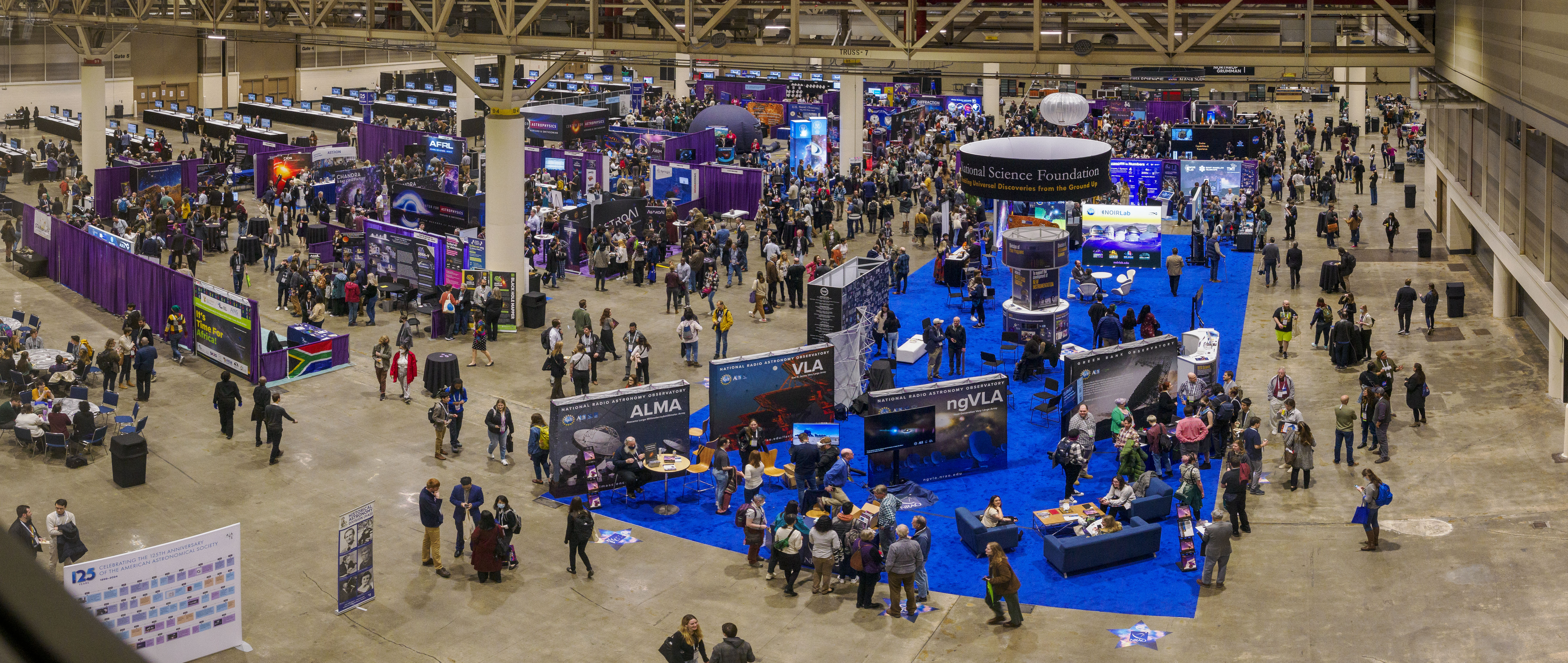
Photo by © CorporateEventImages/Todd Buchanan 2024
The National Science Foundation’s National Radio Astronomy Observatory (NRAO) and Green Bank Observatory (GBO) will present at the 244th meeting of the American Astronomical Society in Madison, Wisconsin, from June 9-13. The full schedule is as follows:
Circumstellar Disk Lifetimes (Press Conference)
Monday, June 10
10:15 a.m. CT
Press Room
CARTA: The Cube Analysis and Rendering Tool for Astronomy
Tuesday, June 11
9:30 a.m. CT
Exb Theater
SuperKnova: Broadening Participation in STEM through E-Learning
Tuesday, June 11
10:00 a.m. CT
Ballroom A
Dust-free Clouds in the Galactic Disk with Toney Minter, GBO (Press Conference)
Tuesday, June 11
10:15 a.m. CT
Press Room
Twin Jets and Disks: JWST MIRI and ALMA Discoveries (Press Conference)
Wednesday, June 12
10:15 a.m. CT
Press Room
Please note: locations and times are subject to change. Refer to the official AAS block schedule for the latest information.
Conference attendees are encouraged to visit booth 19 in the Exhibit Hall to learn about the latest discoveries and initiatives at AUI and its managed facilities and their latest projects. The NRAO and GBO will also be exhibiting at booths 21 and 27, respectively.


Recent News
Twisted Physics: Astronomers Solve 30-Year-Old Stellar Mystery
Astronomers using the Atacama Large Millimeter/submillimeter Array (ALMA) have captured the first direct, high-resolution images of a magnetic field wrapped tightly around the outflow of gas streaming away from a forming star — evidence that solves a decades-old puzzle about how young stars sculpt the powerful jets that form them.
A Trillion Mile Cosmic Stream of Gas Feeds GW Orionis
A team of astronomers using the Atacama Large Millimeter/submillimeter Array (ALMA), of which the U.S. National Science Foundation National Radio Astronomy Observatory is a partner, has captured a massive stream of gas—one trillion miles, or .2 light years long—feeding the young triple-star system GW Orionis.
NSF NRAO radio observations help rule out a relativistic jet in rare stellar explosion
Astronomers studying a rare stellar explosion first spotted as a brief burst of X-rays used radio observations to help show that the dying star did not produce the powerful jet often associated with gamma-ray bursts.