
To celebrate the Inspiration4 Mission’s 5th Anniversary, mission pilot Dr. Sian Proctor is choosing to celebrate in a fitting way — raising funds to send community college students and faculty to Space Camp.
Recent News
10 Questions: Judelyn Padgett
Meet Judelyn Padgett, a project manager at AUI headquarters.
NA-ROAD Announces the 2026 Women and Girls in Astronomy Program Cohort
The Women and Girls in Astronomy Program (WGAP), led by Associated Universities, Inc. (AUI), under the North American Regional Office of Astronomy for Development (NA-ROAD), is proud to announce the selection of ten regional projects to receive funding through the 2026 cycle.
ALMA Gets a New Heartbeat
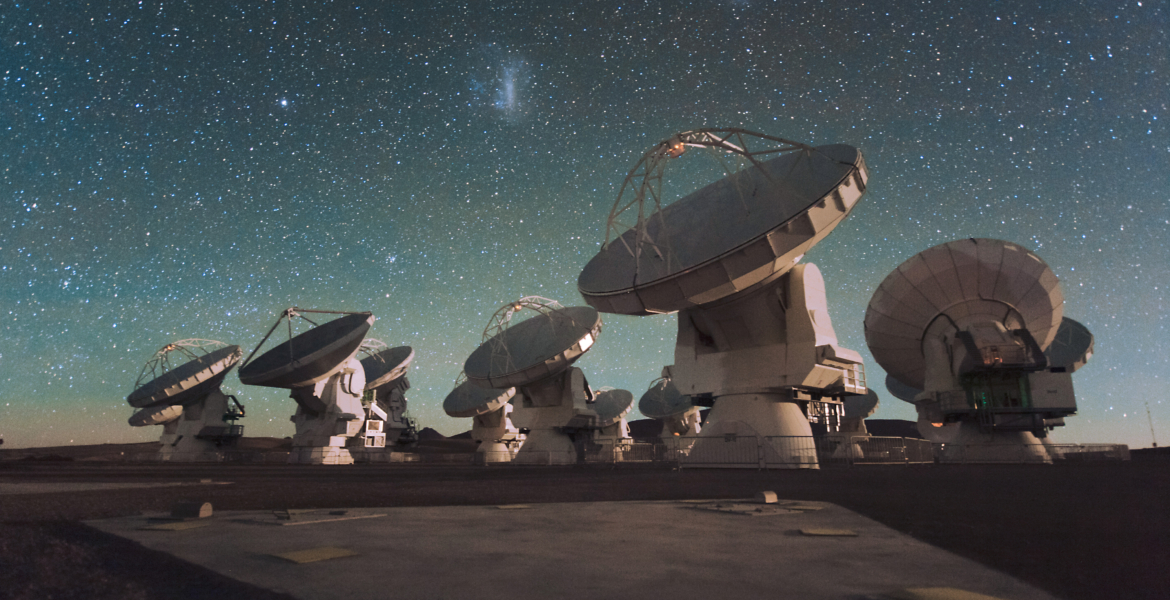
Credit: NSF/NRAO/ESO
The Atacama Large Millimeter/submillimeter Array (ALMA) has just received a “heart transplant,” high in the Atacama Desert in Northern Chile.
The Atacama Large Millimeter/submillimeter Array (ALMA) has just received a “heart transplant,” high in the Atacama Desert in Northern Chile. ALMA, the most complex astronomical observatory ever built on Earth, installed a new hydrogen maser. Funded by the National Radio Astronomy Observatory (NRAO), this upgrade marks an essential investment, setting a new standard in reliability for observations.
A maser is an advanced atomic clock that uses the properties of the hydrogen atom to provide an extremely precise and stable frequency reference. This precision is crucial for Very Long Baseline Interferometry (VLBI) observations, enabling the synchronization of cosmic signals received by networks of telescopes spread across the globe. A brief, but fascinating, video brings together many voices across the international ALMA team to share the process of the replacement and its importance:
The new maser, now the heartbeat of ALMA’s operations, ensures a high level of accuracy essential for detailed explorations of the Universe. ALMA is a cornerstone of international astronomy as part of the Event Horizon Telescope, and other Very Long Baseline Interferometry studies, most famously revealing the first image of black hole M87* and Sagittarius A*, at the center of our own Milky Way Galaxy.
The integration of the new maser into the ALMA Array was aided by the Massachusetts Institute of Technology Haystack Observatory. The original maser remains operating as a backup, strengthening ALMA’s resilience against potential system failures and ensuring reliable, continuous astronomical research. This upgrade solidifies ALMA’s position at the forefront of astronomical research, enabling astronomers to uncover more mysteries of the Universe with greater accuracy and reliability.
About ALMA & NRAO
The Atacama Large Millimeter/submillimeter Array (ALMA), an international astronomy facility, is a partnership of the European Organisation for Astronomical Research in the Southern Hemisphere (ESO), the U.S. National Science Foundation (NSF) and the National Institutes of Natural Sciences (NINS) of Japan in cooperation with the Republic of Chile. ALMA is funded by ESO on behalf of its Member States, by NSF in cooperation with the National Research Council of Canada (NRC) and the Ministry of Science and Technology (MOST) and by NINS in cooperation with the Academia Sinica (AS) in Taiwan and the Korea Astronomy and Space Science Institute (KASI).
ALMA construction and operations are led by ESO on behalf of its Member States; by the National Radio Astronomy Observatory (NRAO), managed by Associated Universities, Inc. (AUI), on behalf of North America; and by the National Astronomical Observatory of Japan (NAOJ) on behalf of East Asia. The Joint ALMA Observatory (JAO) provides the unified leadership and management of the construction, commissioning and operation of ALMA.
NRAO is a facility of the National Science Foundation, operated under cooperative agreement by Associated Universities, Inc.
This news article was originally published on the NRAO website on February 6, 2024.


Recent News
Proctor Foundation for Art and Science Offers Stellar Guitar to Space Camp Auction
To celebrate the Inspiration4 Mission’s 5th Anniversary, mission pilot Dr. Sian Proctor is choosing to celebrate in a fitting way — raising funds to send community college students and faculty to Space Camp.
10 Questions: Judelyn Padgett
Meet Judelyn Padgett, a project manager at AUI headquarters.
NA-ROAD Announces the 2026 Women and Girls in Astronomy Program Cohort
The Women and Girls in Astronomy Program (WGAP), led by Associated Universities, Inc. (AUI), under the North American Regional Office of Astronomy for Development (NA-ROAD), is proud to announce the selection of ten regional projects to receive funding through the 2026 cycle.