
Astronomers using the Atacama Large Millimeter/submillimeter Array (ALMA) have captured the first direct, high-resolution images of a magnetic field wrapped tightly around the outflow of gas streaming away from a forming star — evidence that solves a decades-old puzzle about how young stars sculpt the powerful jets that form them.
Recent News
A Trillion Mile Cosmic Stream of Gas Feeds GW Orionis
A team of astronomers using the Atacama Large Millimeter/submillimeter Array (ALMA), of which the U.S. National Science Foundation National Radio Astronomy Observatory is a partner, has captured a massive stream of gas—one trillion miles, or .2 light years long—feeding the young triple-star system GW Orionis.
NSF NRAO radio observations help rule out a relativistic jet in rare stellar explosion
Astronomers studying a rare stellar explosion first spotted as a brief burst of X-rays used radio observations to help show that the dying star did not produce the powerful jet often associated with gamma-ray bursts.
Astronomers Discover Most Massive Neutron Star—or Least Massive Black Hole
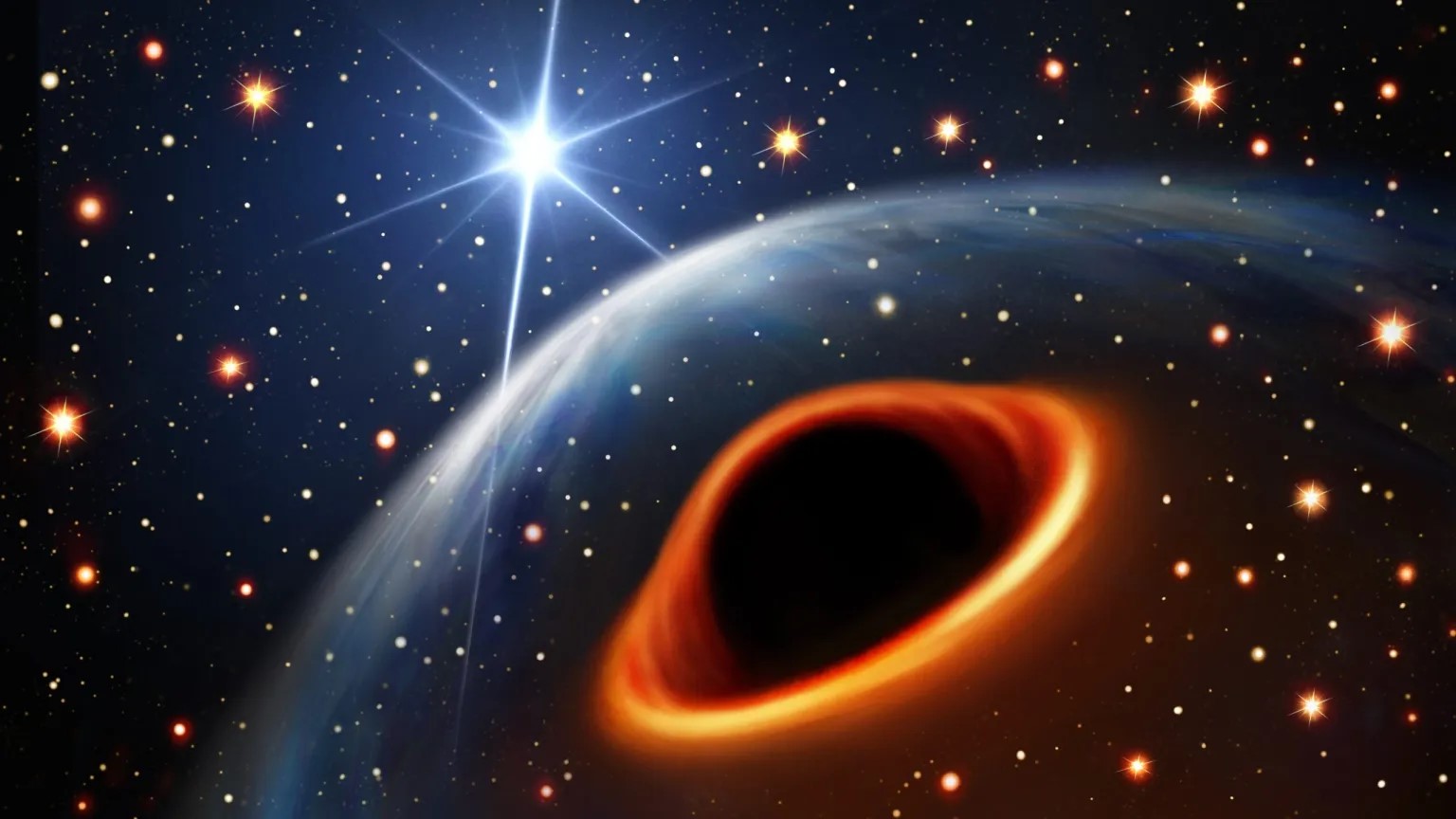
An artist’s impression of the system assuming that the massive companion star is a black hole. The brightest background star is its orbital companion, the radio pulsar PSR J0514-4002E. The two stars are separated by 8 million km and orbit each other every 7 days. Credit: Daniëlle Futselaar (artsource.nl)
Green Bank Telescope helps MeerKAT uncover a mysterious object at the boundary between black holes and neutron stars
An international team of astronomers have discovered a massive dark object in orbit around a rapidly spinning millisecond pulsar.
“We found a pulsar orbiting a massive and mysterious companion star,” shares Scott Ransom, a scientist with the National Radio Astronomy Observatory, “It is either the most massive neutron star known, or the least massive black hole ever observed. Either one is amazing.”
This unusual object was found as part of a binary system, a pulsar and an unknown compact object, in the globular cluster NGC 1851. Globular clusters are unique environments with hundreds of thousands of stars packed closely together, and likely places to produce strange cosmological pairs.
Astronomers used the pulsar, PSR J0514-4002E, to measure the pair’s precise location and reveal the unusual mass of its partner—simultaneously bigger than any known neutron star and yet smaller than any known black hole. This could be the first discovery of a long anticipated pulsar-black hole binary; a stellar pairing that would allow new tests of Einstein’s general relativity. “We don’t know how big neutron stars can get before they collapse into black holes. This source will help us figure that out,” adds Ransom.
This research, published today in the journal Science, combined several years of archival data from the National Science Foundations Green Bank Telescope with new data from the South African Radio Astronomy Observatory’s MeerKAT.
“This exciting discovery shows how important access to legacy data from our major instruments is,” shares Ransom. “After we found the pulsar in the fantastic new MeerKAT data, we were able to detect the pulsar in several GBT observations of the cluster from 2005 and 2006, and show that the orbit had subtly changed over time due to the massive companion star. The Green Bank Telescope has nearly two decades worth of other data that could be really valuable for the astronomy community, and the Observatory is working hard to make all of it available.”
A zoom into the globular cluster NGC 1851 followed by an orbital simulation showing the original pulsar – white dwarf binary being disrupted by the arrival of a massive third body of unknown nature. The new arrival kicks the white dwarf out of orbit and captures the pulsar for itself, forming a new binary system with a pulsar in orbit around, most likely, either a light black hole or a supermassive neutron star. Credit: OzGrav, Swinburne University of Technology.
While astronomers cannot conclusively say whether they have discovered the most massive neutron star known, the least massive black hole known, or even some new exotic star variant, what is certain is that they have uncovered a unique laboratory for probing the properties of matter under the most extreme conditions in the Universe.
Read more at the Max Planck Institute for Radio Astronomy.
This news article was originally published on the GBO website on January 18, 2024.


Recent News
Twisted Physics: Astronomers Solve 30-Year-Old Stellar Mystery
Astronomers using the Atacama Large Millimeter/submillimeter Array (ALMA) have captured the first direct, high-resolution images of a magnetic field wrapped tightly around the outflow of gas streaming away from a forming star — evidence that solves a decades-old puzzle about how young stars sculpt the powerful jets that form them.
A Trillion Mile Cosmic Stream of Gas Feeds GW Orionis
A team of astronomers using the Atacama Large Millimeter/submillimeter Array (ALMA), of which the U.S. National Science Foundation National Radio Astronomy Observatory is a partner, has captured a massive stream of gas—one trillion miles, or .2 light years long—feeding the young triple-star system GW Orionis.
NSF NRAO radio observations help rule out a relativistic jet in rare stellar explosion
Astronomers studying a rare stellar explosion first spotted as a brief burst of X-rays used radio observations to help show that the dying star did not produce the powerful jet often associated with gamma-ray bursts.