
Astronomers using the Atacama Large Millimeter/submillimeter Array (ALMA) have captured the first direct, high-resolution images of a magnetic field wrapped tightly around the outflow of gas streaming away from a forming star — evidence that solves a decades-old puzzle about how young stars sculpt the powerful jets that form them.
Recent News
A Trillion Mile Cosmic Stream of Gas Feeds GW Orionis
A team of astronomers using the Atacama Large Millimeter/submillimeter Array (ALMA), of which the U.S. National Science Foundation National Radio Astronomy Observatory is a partner, has captured a massive stream of gas—one trillion miles, or .2 light years long—feeding the young triple-star system GW Orionis.
NSF NRAO radio observations help rule out a relativistic jet in rare stellar explosion
Astronomers studying a rare stellar explosion first spotted as a brief burst of X-rays used radio observations to help show that the dying star did not produce the powerful jet often associated with gamma-ray bursts.
ALMA Takes First Step Toward Return to Service
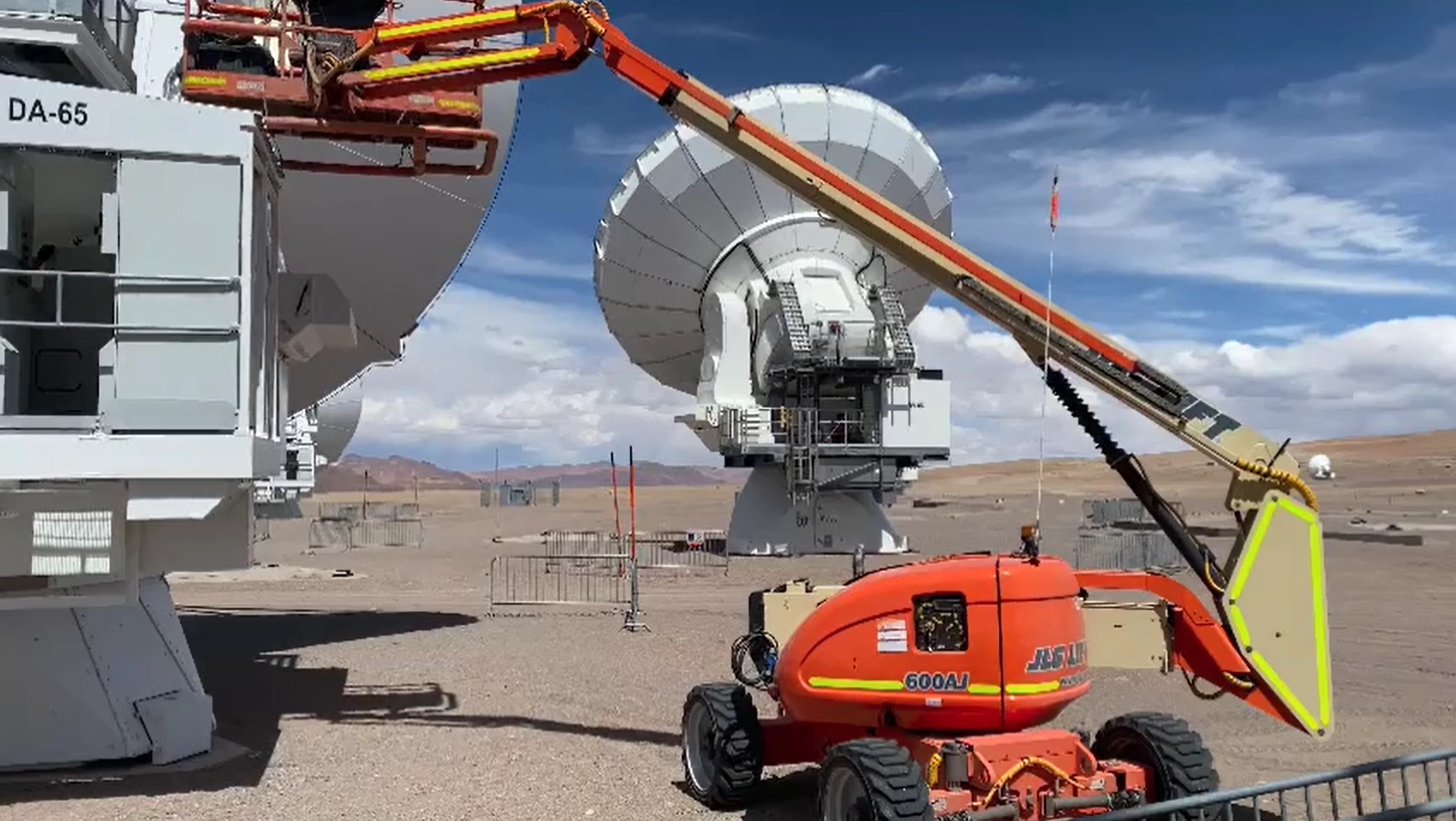
Personnel at the Atacama Large Millimeter/submillimeter Array (ALMA) in Chile have begun the process of returning the facility to an active observational status, following the shutdown caused by COVID-19 in March of 2020. Single-dish test observations of Mars at Band 3 (84-116 GHz) have been completed with two antennas. The first few ALMA antennas are being brought back online initially by powering up their drive systems.
We are grateful to the dedicated crew that is working to bring ALMA back into operation, and are happy to see this successful first step. Much work remains to be done, but we have begun the journey.
The National Radio Astronomy Observatory is a facility of the National Science Foundation, operated under cooperative agreement by Associated Universities, Inc.
###
The Atacama Large Millimeter/submillimeter Array (ALMA), an international astronomy facility, is a partnership of the European Organisation for Astronomical Research in the Southern Hemisphere (ESO), the U.S. National Science Foundation (NSF) and the National Institutes of Natural Sciences (NINS) of Japan in cooperation with the Republic of Chile. ALMA is funded by ESO on behalf of its Member States, by NSF in cooperation with the National Research Council of Canada (NRC) and the Ministry of Science and Technology (MOST) and by NINS in cooperation with the Academia Sinica (AS) in Taiwan and the Korea Astronomy and Space Science Institute (KASI).
ALMA construction and operations are led by ESO on behalf of its Member States; by the National Radio Astronomy Observatory (NRAO), managed by Associated Universities, Inc. (AUI), on behalf of North America; and by the National Astronomical Observatory of Japan (NAOJ) on behalf of East Asia. The Joint ALMA Observatory (JAO) provides the unified leadership and management of the construction, commissioning and operation of ALMA.
###
This news article was originally published on the NRAO website on January 14, 2021.


Recent News
Twisted Physics: Astronomers Solve 30-Year-Old Stellar Mystery
Astronomers using the Atacama Large Millimeter/submillimeter Array (ALMA) have captured the first direct, high-resolution images of a magnetic field wrapped tightly around the outflow of gas streaming away from a forming star — evidence that solves a decades-old puzzle about how young stars sculpt the powerful jets that form them.
A Trillion Mile Cosmic Stream of Gas Feeds GW Orionis
A team of astronomers using the Atacama Large Millimeter/submillimeter Array (ALMA), of which the U.S. National Science Foundation National Radio Astronomy Observatory is a partner, has captured a massive stream of gas—one trillion miles, or .2 light years long—feeding the young triple-star system GW Orionis.
NSF NRAO radio observations help rule out a relativistic jet in rare stellar explosion
Astronomers studying a rare stellar explosion first spotted as a brief burst of X-rays used radio observations to help show that the dying star did not produce the powerful jet often associated with gamma-ray bursts.