
Astronomers using the Atacama Large Millimeter/submillimeter Array (ALMA) have captured the first direct, high-resolution images of a magnetic field wrapped tightly around the outflow of gas streaming away from a forming star — evidence that solves a decades-old puzzle about how young stars sculpt the powerful jets that form them.
Recent News
A Trillion Mile Cosmic Stream of Gas Feeds GW Orionis
A team of astronomers using the Atacama Large Millimeter/submillimeter Array (ALMA), of which the U.S. National Science Foundation National Radio Astronomy Observatory is a partner, has captured a massive stream of gas—one trillion miles, or .2 light years long—feeding the young triple-star system GW Orionis.
NSF NRAO radio observations help rule out a relativistic jet in rare stellar explosion
Astronomers studying a rare stellar explosion first spotted as a brief burst of X-rays used radio observations to help show that the dying star did not produce the powerful jet often associated with gamma-ray bursts.
Astrophotography Workshop Announced at Iconic Very Large Array
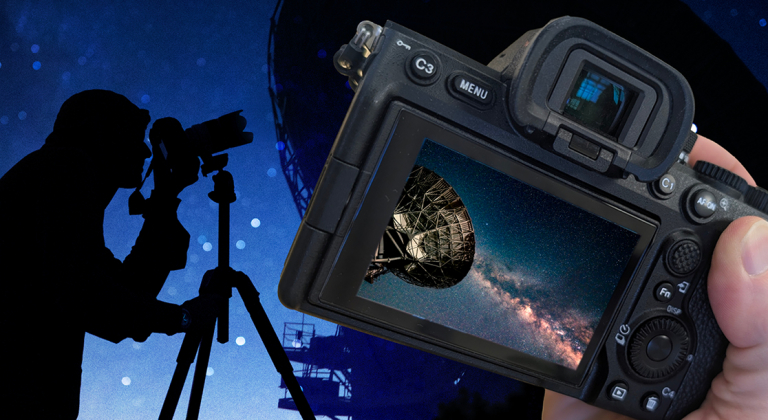
Image credit: NSF/AUI/NSF NRAO/J. Hellerman
Photography enthusiasts and stargazers alike are invited to experience an unforgettable evening of learning and exploration at the U.S. National Science Foundation Very Large Array (NSF VLA) located 25 miles west of Magdalena, New Mexico. This is the U.S. National Science Foundation National Radio Astronomy Observatory (NSF NRAO)’s first-ever Astrophotography Workshop, and it will take place on April 18, 2026. This workshop offers participants the rare opportunity to capture stunning images of the cosmos from one of the world’s most remarkable and bespoke astronomical settings.
The four-hour workshop, priced at $100 per participant, is designed for photographers of all skill levels who are eager to improve their night sky photography techniques. The event will begin with a two-hour instructional session, where attendees will learn essential skills such as proper camera settings for low-light conditions, composition strategies, and focusing methods for capturing stars, constellations, and the Milky Way.
Following the classroom portion, participants will transition into a two-hour guided, hands-on photography session among the NSF VLA’s iconic radio telescope dishes – including the ngVLA prototype antenna which has yet to be photographed under the night sky! With expert guidance, attendees will apply their new knowledge in real time, photographing the night sky in a uniquely dramatic and inspiring environment.
“The Very Large Array offers an unparalleled backdrop for astrophotography,” said Jeff Hellerman, NSF NRAO photographer and event organizer. “This workshop will give participants both the technical foundation and the hands-on experience needed to confidently capture the beauty of the night sky – in one of the most unique places on the planet.”
Located on the Plains of San Agustin in central New Mexico, the NSF Very Large Array is internationally renowned for its role in groundbreaking astronomical discoveries and its striking visual presence. Its remote location also provides exceptionally dark skies, making it an ideal setting for night photography.
Participants are required to bring their own DSLR or mirrorless camera and a sturdy tripod. Space is limited to just 20 participants to ensure personalized instruction.
For more information or to reserve a spot, please visit the registration page.
About NRAO
The National Radio Astronomy Observatory is a major facility of the U.S. National Science Foundation, operated under cooperative agreement by Associated Universities, Inc.
This news article was originally published on the NRAO website on MArch 24, 2026.


Recent News
Twisted Physics: Astronomers Solve 30-Year-Old Stellar Mystery
Astronomers using the Atacama Large Millimeter/submillimeter Array (ALMA) have captured the first direct, high-resolution images of a magnetic field wrapped tightly around the outflow of gas streaming away from a forming star — evidence that solves a decades-old puzzle about how young stars sculpt the powerful jets that form them.
A Trillion Mile Cosmic Stream of Gas Feeds GW Orionis
A team of astronomers using the Atacama Large Millimeter/submillimeter Array (ALMA), of which the U.S. National Science Foundation National Radio Astronomy Observatory is a partner, has captured a massive stream of gas—one trillion miles, or .2 light years long—feeding the young triple-star system GW Orionis.
NSF NRAO radio observations help rule out a relativistic jet in rare stellar explosion
Astronomers studying a rare stellar explosion first spotted as a brief burst of X-rays used radio observations to help show that the dying star did not produce the powerful jet often associated with gamma-ray bursts.