
New research reveals that 3I/ATLAS is packed with an unusually large amount of the organic molecule methanol – more than almost all known comets in our own solar system.
Recent News
10 Questions: Anica Miller-Rushing
Meet Anica Miller-Rushing, STEM education research associate for AUI’s Office of Education and Public Engagement.
A Quintillion-to-One: Giant Stars, Tiny Dust
Astronomers using the Atacama Large Millimeter/submillimeter Array (ALMA) and NASA’s James Webb Space Telescope (JWST) have discovered that some of the most massive stars in our galaxy are emitting unbelievably tiny grains of carbon dust—dust that one day could form future stars and planets.
Super Massive Black Holes May Be Picky Eaters
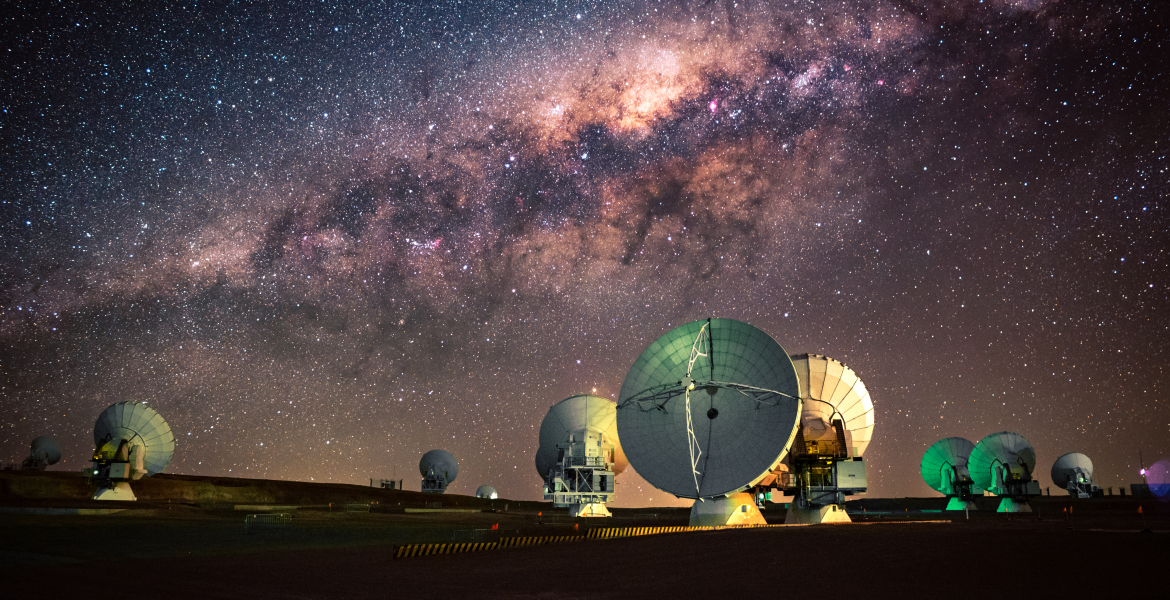
The Milky Way Galaxy stretches over ALMA and the Chajnantor plateau of the Chilean Andes. The Large and Small Magellanic Clouds can also be seen in this panorama that was stitched together from multiple photos. Image credit: NSF/ AUI/ NSF NRAO/ B.Foott
New ALMA research reveals galaxy mergers that feed black holes may be not be a the buffet astronomers previously thought
Black holes are notorious for gobbling up everything that comes their way, but astronomers using the Atacama Large Millimeter/submillimeter Array (ALMA) have discovered that even supermassive black holes can be picky eaters, and this can have a significant impact on their growth. This discovery was made by an international team of astronomers led by Makoto A. Johnstone, a PhD candidate with the University of Virginia. The team used ALMA to study seven nearby galaxy mergers hosting supermassive black holes separated by only a few thousand light‑years.
When two massive, gas‑rich galaxies merge, gravity drives vast amounts of cold molecular gas toward the centers of both systems, where supermassive black holes (SMBHs) reside. These brief, turbulent phases can light up one or both black holes as active galactic nuclei (AGN), making them some of the most energetic objects in the universe. Yet, puzzlingly, not all merging galaxies host two actively feeding black holes; some show only one, while others seem to have no appetite.
These observations revealed a dense, chaotic pile of gas clouds around many of the black holes (especially the more massive ones), meaning mergers are very effective at delivering the food for growth right to their doorsteps. Yet the current brightness of the black holes (a measure of how fast they are feeding) does not increase with the amount of gas available. Even with plenty of food nearby, most SMBHs are nibbling rather than gorging, suggesting that black hole growth during mergers could be highly inefficient, with an inconsistent digestion of gas on short timescales. “The inefficiency of the observed supermassive black hole growth, even when dense reservoirs of molecular gas are present, raises questions about the physical conditions necessary to trigger these growth episodes,” said Makoto. “In addition to occurring in extreme dusty environments, the AGN activity is likely highly variable and episodic, explaining why it has been so difficult to detect two simultaneously active black holes in mergers.”
The team compared systems where both black holes were active (dual AGN) with mergers where only one showed obvious activity (single AGN). In some of these single AGN cases, the black hole with no appetite truly seemed starved of cold gas, but in others, the gas was observed, but the black hole still refused to eat, possibly because it was observed between feedings. “These unique ALMA observations show how black holes are actively being fed during a major galaxy merger, an event that we strongly suspect is critical in setting up the observed connection between black hole growth and galaxy evolution. It is only now, thanks to the unique and revolutionary ALMA capabilities, that this study is feasible,” says Ezequiel Treister, principal investigator of this research project, and co-author of the study.
ALMA also finds that many active black holes sit slightly off‑center from their main rotating gas disks, which might be evidence of violent gravitational tussles that displace the black holes during galaxy mergers. Together, these results show that in galaxy collisions, having enough energy to feed SMBHs is only half the story; timing, turbulence, and dust decide when, and if, both black holes flare to life.
About ALMA
The Atacama Large Millimeter/submillimeter Array (ALMA), an international astronomy facility, is a partnership of the European Southern Observatory (ESO), the U.S. National Science Foundation (NSF) and the National Institutes of Natural Sciences (NINS) of Japan in cooperation with the Republic of Chile. ALMA is funded by ESO on behalf of its Member States, by NSF in cooperation with the National Research Council of Canada (NRC) and the National Science and Technology Council (NSTC) in Taiwan and by NINS in cooperation with the Academia Sinica (AS) in Taiwan and the Korea Astronomy and Space Science Institute (KASI).
ALMA construction and operations are led by ESO on behalf of its Member States; by the National Radio Astronomy Observatory (NRAO), managed by Associated Universities, Inc. (AUI), on behalf of North America; and by the National Astronomical Observatory of Japan (NAOJ) on behalf of East Asia. The Joint ALMA Observatory (JAO) provides the unified leadership and management of the construction, commissioning and operation of ALMA.
This news release was originally published on the NRAO website on December 19, 2025.


Recent News
ALMA Detects Extremely Abundant Alcohol in Interstellar Comet 3I/ATLAS
New research reveals that 3I/ATLAS is packed with an unusually large amount of the organic molecule methanol – more than almost all known comets in our own solar system.
10 Questions: Anica Miller-Rushing
Meet Anica Miller-Rushing, STEM education research associate for AUI’s Office of Education and Public Engagement.
A Quintillion-to-One: Giant Stars, Tiny Dust
Astronomers using the Atacama Large Millimeter/submillimeter Array (ALMA) and NASA’s James Webb Space Telescope (JWST) have discovered that some of the most massive stars in our galaxy are emitting unbelievably tiny grains of carbon dust—dust that one day could form future stars and planets.