
The U.S. National Science Foundation National Radio Astronomy Observatory (NSF NRAO) invites the public to the U.S. National Science Foundation Very Large Array (NSF VLA) for its annual Spring Open House on Saturday, April 18, 2026, from 9:00 a.m. to 4:00 p.m.
Recent News
ALMA Detects Extremely Abundant Alcohol in Interstellar Comet 3I/ATLAS
New research reveals that 3I/ATLAS is packed with an unusually large amount of the organic molecule methanol – more than almost all known comets in our own solar system.
10 Questions: Anica Miller-Rushing
Meet Anica Miller-Rushing, STEM education research associate for AUI’s Office of Education and Public Engagement.
NSF VLA and ALMA Reveal Time-Stamps of Star Birth in Dazzling Cosmic Jet
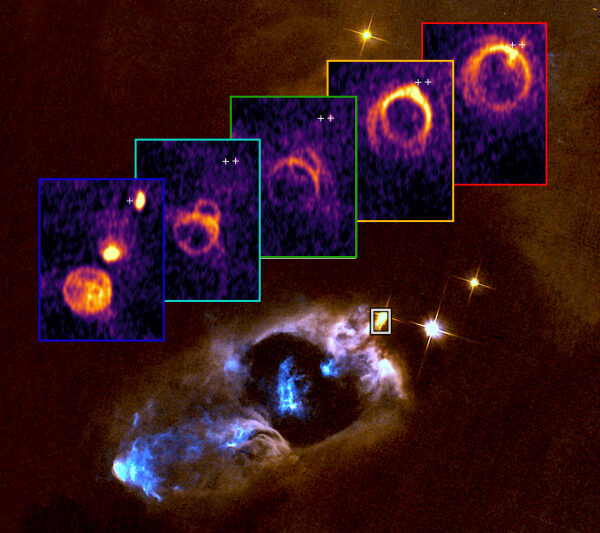
A “tomographic” ALMA view revealing how the supersonic protostellar jet from SVS 13 interacts with the surrounding ambient medium. In the background, a Hubble Space Telescope (HST) image shows the cavity carved out by the outflow, along with the striking Herbig–Haro knots visible at optical wavelengths. Image credit: Guillermo Blázquez-Calero, Mayra Osorio, Guillem Anglada. Background image credit: ESA/Hubble & NASA/Karl Stapelfeldt.
Decades of NSF VLA groundwork enable ALMA’s breakthrough images, uncovering rings in a stellar jet that act as a record of explosive outbursts from a young star
An international group of astronomers has uncovered the clearest evidence yet that the powerful jets launched by newborn stars dependably record a star’s most violent growing pains, confirming a long‑standing model of how these jets plow through their surroundings.
Using the U.S. National Science Foundation Very Large Array (NSF VLA), astronomers first identified SVS 13 as a remarkable binary protostellar system driving a chain of high‑velocity “molecular bullets” and Herbig–Haro shocks in the NGC 1333 star‑forming region, about 1,000 light‑years from Earth. Early NSF VLA continuum images pinpointed the two radio protostars, VLA 4A and VLA 4B, and revealed the larger‑scale outflow that flagged this system as a prime target for deeper investigation of how young stars launch and collimate jets. This decades‑long NSF VLA groundwork made it possible to identify precisely which protostar powers the jet now seen in extraordinary detail.
Building on this legacy, new observations with the Atacama Large Millimeter/submillimeter Array (ALMA) zoomed in on the brightest high‑velocity “bullet” in the SVS 13 outflow and revealed a stunning sequence of nested molecular rings. As the observed velocity changes, each ring smoothly shrinks and shifts position, tracing ultra‑thin, bow‑shaped shells only a few dozen astronomical units thick and moving at up to about 100 kilometers per second. This tomographic view works much like a medical CT scan, allowing astronomers to reconstruct how the jet carves its way through surrounding gas.
“Our observations show that these jets are not just dramatic side effects of star birth—they are also faithful record‑keepers,” said Guillermo Blázquez-Calero, a co-lead author of the study and a researcher at the Instituto de Astrofísica de Andalucía, CSIC (IAA‑CSIC). “Each sequence of rings in the jet carries a time‑stamp of a past outburst, letting us read the history of how material fell onto the young star and was then violently ejected back into its environment.”
By fitting more than 400 individual rings, the team demonstrated that each shell matches a textbook momentum‑conserving bow shock driven by a narrow jet whose speed changes over time. The youngest shell’s age aligns with a powerful optical/infrared outburst of SVS 13 VLA 4B in the early 1990s, providing the first direct link between bursts of material falling onto a young star and changes in the speed of its jet. This means protostellar jets preserve a time‑stamped record of past eruptions, offering new clues to how episodic outbursts reshape the disks that eventually give rise to planets like Earth. You can read the full scientific paper published in Nature Astronomy.
About NRAO
The National Radio Astronomy Observatory is a facility of the U.S. National Science Foundation, operated under cooperative agreement by Associated Universities, Inc.
This news article was originally published on the NRAO website on December 16, 2025.


Recent News
NSF NRAO to Host Spring 2026 VLA Open House
The U.S. National Science Foundation National Radio Astronomy Observatory (NSF NRAO) invites the public to the U.S. National Science Foundation Very Large Array (NSF VLA) for its annual Spring Open House on Saturday, April 18, 2026, from 9:00 a.m. to 4:00 p.m.
ALMA Detects Extremely Abundant Alcohol in Interstellar Comet 3I/ATLAS
New research reveals that 3I/ATLAS is packed with an unusually large amount of the organic molecule methanol – more than almost all known comets in our own solar system.
10 Questions: Anica Miller-Rushing
Meet Anica Miller-Rushing, STEM education research associate for AUI’s Office of Education and Public Engagement.