
Astronomers using the Atacama Large Millimeter/submillimeter Array (ALMA) have captured the first direct, high-resolution images of a magnetic field wrapped tightly around the outflow of gas streaming away from a forming star — evidence that solves a decades-old puzzle about how young stars sculpt the powerful jets that form them.
Recent News
A Trillion Mile Cosmic Stream of Gas Feeds GW Orionis
A team of astronomers using the Atacama Large Millimeter/submillimeter Array (ALMA), of which the U.S. National Science Foundation National Radio Astronomy Observatory is a partner, has captured a massive stream of gas—one trillion miles, or .2 light years long—feeding the young triple-star system GW Orionis.
NSF NRAO radio observations help rule out a relativistic jet in rare stellar explosion
Astronomers studying a rare stellar explosion first spotted as a brief burst of X-rays used radio observations to help show that the dying star did not produce the powerful jet often associated with gamma-ray bursts.
NSF NRAO Hosts SpectrumX Field Experiment at the Very Large Array
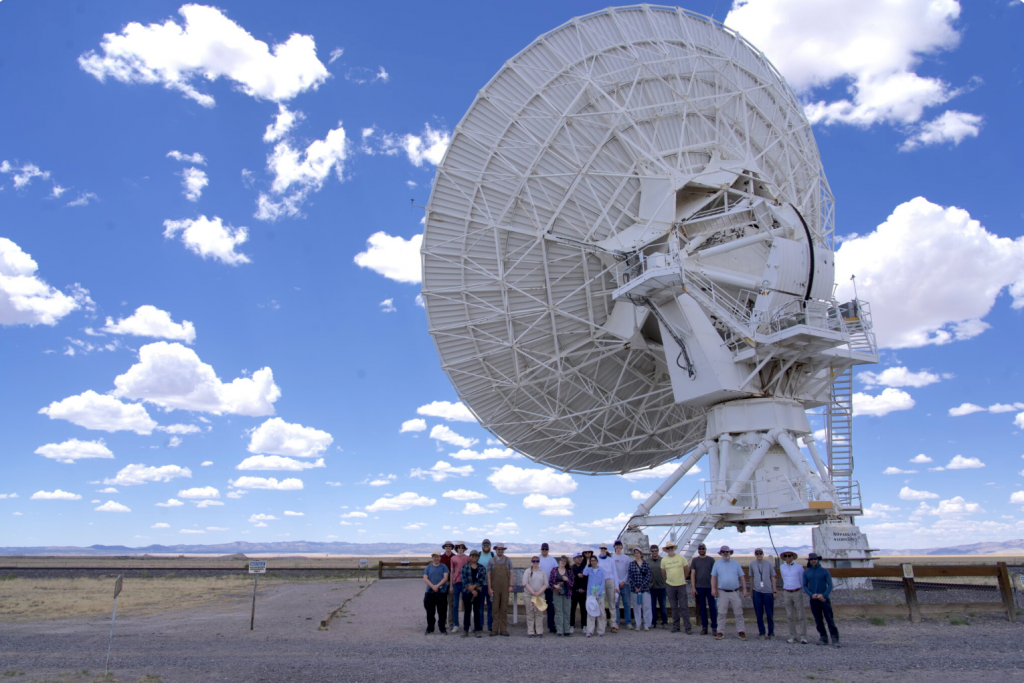
The U. S. National Science Foundation’s National Radio Astronomy Observatory (NSF NRAO) recently collaborated with NSF SpectrumX, the Spectrum Innovation Center, to host a large-scale spectrum research experiment at the U.S. National Science Foundation Very Large Array (NSF VLA) in New Mexico.
This week-long effort, conducted in July 2025, brought together researchers, students, and experts from across academia, government, and industry to study spectrum usage in the 7.125 to 7.4 GHz band—frequencies of increasing importance to both science and emerging sixth-generation (6G) communications. Because of the unique sensitivity of the NSF VLA, the experiment provided a vital opportunity to explore how future spectrum allocations may affect radio astronomy and other passive scientific applications. Read the full release.
About NRAO
The National Radio Astronomy Observatory is a facility of the U.S. National Science Foundation, operated under cooperative agreement by Associated Universities, Inc.
Contact:
Corrina C. Jaramillo Feldman, Senior Public Information Officer
National Radio Astronomy Observatory
[email protected]
(505) 366-7267
public.nrao.edu
About SpectrumX
SpectrumX is funded by the NSF as part of its Spectrum Innovation Initiative, under grant number AST 21-32700. SpectrumX is the world’s largest academic hub where all radio spectrum stakeholders can innovate, collaborate, and contribute to maximizing social welfare of this precious resource.
To learn more about SpectrumX, please visit spectrumx.org.
Contact:
Stephanie Loney, Research Communications Specialist
NSF SpectrumX / Notre Dame Research / University of Notre Dame
[email protected] / 574.631.7804
spectrumx.org
This news article was originally published on the NRAO website on September 2, 2025.


Recent News
Twisted Physics: Astronomers Solve 30-Year-Old Stellar Mystery
Astronomers using the Atacama Large Millimeter/submillimeter Array (ALMA) have captured the first direct, high-resolution images of a magnetic field wrapped tightly around the outflow of gas streaming away from a forming star — evidence that solves a decades-old puzzle about how young stars sculpt the powerful jets that form them.
A Trillion Mile Cosmic Stream of Gas Feeds GW Orionis
A team of astronomers using the Atacama Large Millimeter/submillimeter Array (ALMA), of which the U.S. National Science Foundation National Radio Astronomy Observatory is a partner, has captured a massive stream of gas—one trillion miles, or .2 light years long—feeding the young triple-star system GW Orionis.
NSF NRAO radio observations help rule out a relativistic jet in rare stellar explosion
Astronomers studying a rare stellar explosion first spotted as a brief burst of X-rays used radio observations to help show that the dying star did not produce the powerful jet often associated with gamma-ray bursts.