
To celebrate the Inspiration4 Mission’s 5th Anniversary, mission pilot Dr. Sian Proctor is choosing to celebrate in a fitting way — raising funds to send community college students and faculty to Space Camp.
Recent News
10 Questions: Judelyn Padgett
Meet Judelyn Padgett, a project manager at AUI headquarters.
NA-ROAD Announces the 2026 Women and Girls in Astronomy Program Cohort
The Women and Girls in Astronomy Program (WGAP), led by Associated Universities, Inc. (AUI), under the North American Regional Office of Astronomy for Development (NA-ROAD), is proud to announce the selection of ten regional projects to receive funding through the 2026 cycle.
Brightest Ever Fast Radio Burst Allows Researchers To Identify Its Origin
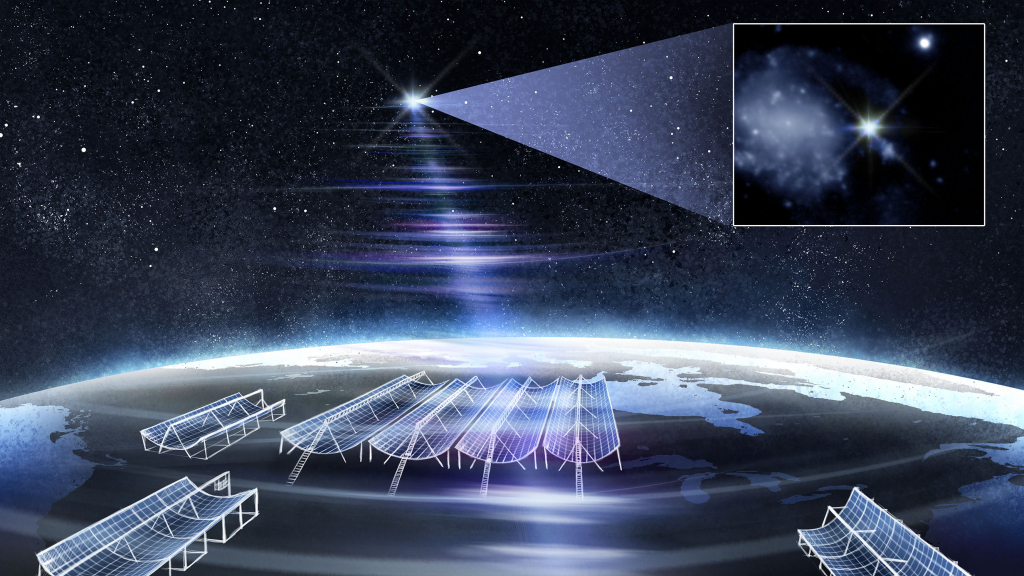
Artist’s rendition of CHIME/FRB and its Outriggers localizing FRB 20250316A (RBFLOAT.) Inset: The host galaxy (NGC 4141) as imaged by the MMT Observatory (PI: Yuxin (Vic) Dong), illustrates the location of the FRB within a spiral arm of NGC 4141. Credit: Daniëlle Futselaar/MMT Observatory
Astronomers use newly deployed telescopes and deep-space imaging to challenge long-held assumptions about what causes these mysterious cosmic signals
An international team of astronomers have observed one of the brightest fast radio bursts (FRBs) ever detected—and pinpointed its location in a nearby galaxy (NGC 4141). FRB 20250316A has been nicknamed RBFLOAT, which stands for Radio Brightest FLash Of All Time. The finding and the discovery of the location surprised the team and revealed new insight into FRBs, which are one of astrophysics’ biggest mysteries.
FRBs are powerful, millisecond-long flashes of radio waves from space. Researchers suspect that they are the result of extreme cosmic events but have, so far, been unable to determine their exact origin. FRBs are notoriously difficult to study because they vanish in the blink of an eye.
This discovery was made using the Canadian Hydrogen Intensity Mapping Experiment (CHIME), one of the premier instruments used to study FRBs, along with data from NASA’s JWST. One of CHIME’s telescopes (also called outriggers) is located in the National Radio Quiet Zone on the campus of the U.S. National Science Foundation Green Bank Observatory. This outrigger is one of several CHIME telescopes distributed across North America, which also includes locations in British Columbia and California, designed to work together for very long baseline interferometry (VLBI). A co-author on the paper, Fengqiu Adam Dong, is a Jansky Fellow based at the NSF Green Bank Observatory.
The Green Bank Outrigger, combined with the rest of the array, allowed researchers to triangulate RBFLOAT’s position with extremely high spatial resolution, down to tens of milliarcseconds, which corresponds to approximately 13 parsecs (or 45 light-years) at the FRB’s distance.
This news was adapted from press releases from several institutions involved with this research, including McGill University and the Center for Astrophysics | Harvard & Smithsonian.
This news article was originally published on the NRAO website on August 21, 2025.


Recent News
Proctor Foundation for Art and Science Offers Stellar Guitar to Space Camp Auction
To celebrate the Inspiration4 Mission’s 5th Anniversary, mission pilot Dr. Sian Proctor is choosing to celebrate in a fitting way — raising funds to send community college students and faculty to Space Camp.
10 Questions: Judelyn Padgett
Meet Judelyn Padgett, a project manager at AUI headquarters.
NA-ROAD Announces the 2026 Women and Girls in Astronomy Program Cohort
The Women and Girls in Astronomy Program (WGAP), led by Associated Universities, Inc. (AUI), under the North American Regional Office of Astronomy for Development (NA-ROAD), is proud to announce the selection of ten regional projects to receive funding through the 2026 cycle.