
Astronomers using the Atacama Large Millimeter/submillimeter Array (ALMA) have captured the first direct, high-resolution images of a magnetic field wrapped tightly around the outflow of gas streaming away from a forming star — evidence that solves a decades-old puzzle about how young stars sculpt the powerful jets that form them.
Recent News
A Trillion Mile Cosmic Stream of Gas Feeds GW Orionis
A team of astronomers using the Atacama Large Millimeter/submillimeter Array (ALMA), of which the U.S. National Science Foundation National Radio Astronomy Observatory is a partner, has captured a massive stream of gas—one trillion miles, or .2 light years long—feeding the young triple-star system GW Orionis.
NSF NRAO radio observations help rule out a relativistic jet in rare stellar explosion
Astronomers studying a rare stellar explosion first spotted as a brief burst of X-rays used radio observations to help show that the dying star did not produce the powerful jet often associated with gamma-ray bursts.
Astronomers Detect Earliest and Most Distant Blazar in the Universe
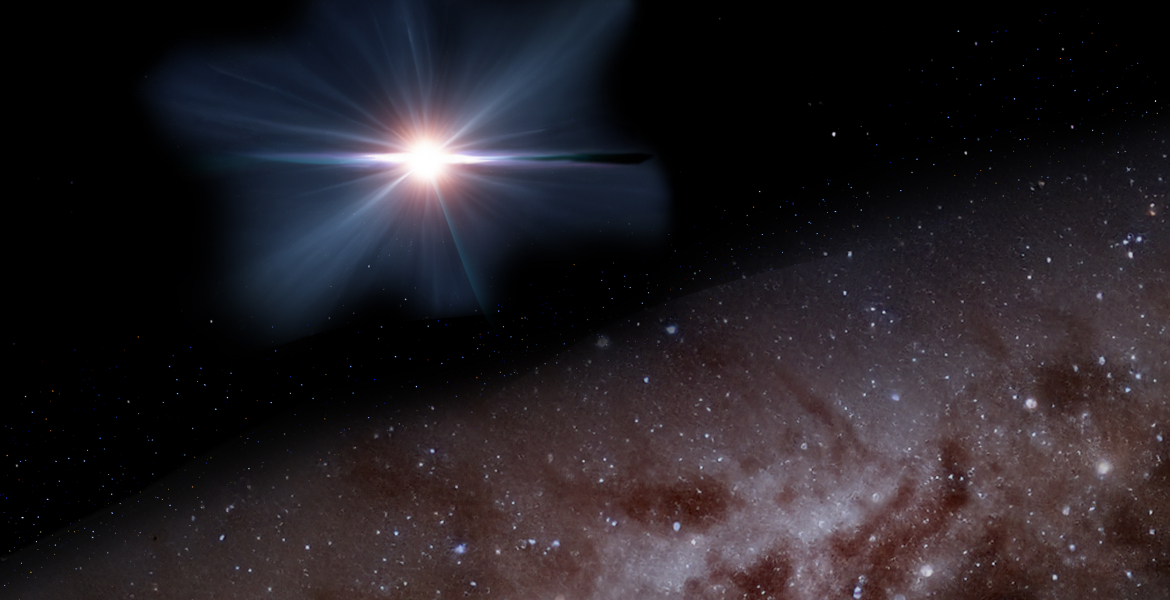
A groundbreaking discovery has revealed the presence of a blazar—a supermassive black hole with a jet pointed directly at Earth—at an extraordinary redshift of 7.0. The object, designated VLASS J041009.05−013919.88 (J0410−0139), is the most distant blazar ever identified, providing a rare glimpse into the epoch of reionization when the universe was less than 800 million years old. This discovery challenges existing models of black hole and galaxy formation in the early cosmos.
J0410−0139 is powered by a black hole with a mass of 700 million times that of the Sun. Multi-wavelength observations show that its radio variability, compact structure, and X-ray properties identify it as a blazar with a jet aligned toward Earth. Blazars are rare and account for only a small fraction of all quasars. The discovery of J0410−0139 implies the existence of a much larger population of similar jetted sources in the early universe. These jets likely enhance black hole growth and significantly affect their host galaxies.
Observations with instruments such as the U.S. National Science Foundation Very Large Array (NSF VLA), the NSF Very Long Baseline Array (NSF VLBA), the Chandra X-ray Observatory, and the Atacama Large Millimeter/submillimeter Array (ALMA) indicate that J0410−0139 exhibits radio emission amplified by relativistic beaming, a hallmark of blazars. Its spectrum also confirms stable accretion and emission regions typical of active black holes. This discovery raises questions about how supermassive black holes grow so rapidly in the universe’s infancy. Models may need to account for jet-enhanced accretion or obscured, super-Eddington growth to reconcile this finding with the known black hole population at such high redshifts.
“This blazar offers a unique laboratory to study the interplay between jets, black holes, and their environments during one of the universe’s most transformative epochs,” said Dr. Emmanuel Momjian of the NSF National Radio Astronomy Observatory, a co-lead of the study, “The alignment of J0410−0139’s jet with our line of sight allows astronomers to peer directly into the heart of this cosmic powerhouse.”
The existence of J0410−0139 at such an early time suggests that current radio surveys might uncover additional jetted quasars from the same era. Understanding these objects will illuminate the role of jets in shaping galaxies and growing supermassive black holes in the early universe.
About NRAO
The NSF National Radio Astronomy Observatory (NSF NRAO) is a facility of the U.S. National Science Foundation, operated under cooperative agreement by Associated Universities, Inc.
For media inquiries or further information, please contact:
NRAO Media Contact: Corrina C. Jaramillo Feldman
Public Information Officer – New Mexico
Tel: +1 505-366-7267
[email protected]
This news article was originally published on the NRAO website on December 18, 2024.


Recent News
Twisted Physics: Astronomers Solve 30-Year-Old Stellar Mystery
Astronomers using the Atacama Large Millimeter/submillimeter Array (ALMA) have captured the first direct, high-resolution images of a magnetic field wrapped tightly around the outflow of gas streaming away from a forming star — evidence that solves a decades-old puzzle about how young stars sculpt the powerful jets that form them.
A Trillion Mile Cosmic Stream of Gas Feeds GW Orionis
A team of astronomers using the Atacama Large Millimeter/submillimeter Array (ALMA), of which the U.S. National Science Foundation National Radio Astronomy Observatory is a partner, has captured a massive stream of gas—one trillion miles, or .2 light years long—feeding the young triple-star system GW Orionis.
NSF NRAO radio observations help rule out a relativistic jet in rare stellar explosion
Astronomers studying a rare stellar explosion first spotted as a brief burst of X-rays used radio observations to help show that the dying star did not produce the powerful jet often associated with gamma-ray bursts.