
A small cohort of educators, scientists and environmental leaders will embark March 3-14 to the southern edge of the world for Mission Patagonia, an immersive outdoor environmental education experience designed to foster deep connection to place, people and planet.
Recent News
AARO Releases Report on Unidentified Anomalous Phenomena (UAP)
The U.S. Department of Defense recently released 2025 UAP Workshop: Narrative Data, Infrastructures, and Analysis. The report details key findings from the workshop conducted at AUI headquarters in August of 2025.
OCEAN Kids ‘Nurdle Patrol’ Engages Students and Builds Environmental Knowledge
“OCEAN Kids: Nurdle Patrol” empowers children to fight plastic pollution by enrolling them in a playful, audio-led “Secret Agent” mission.
ALMA Reveals Stunning Details of Infant Galaxies in the Early Universe
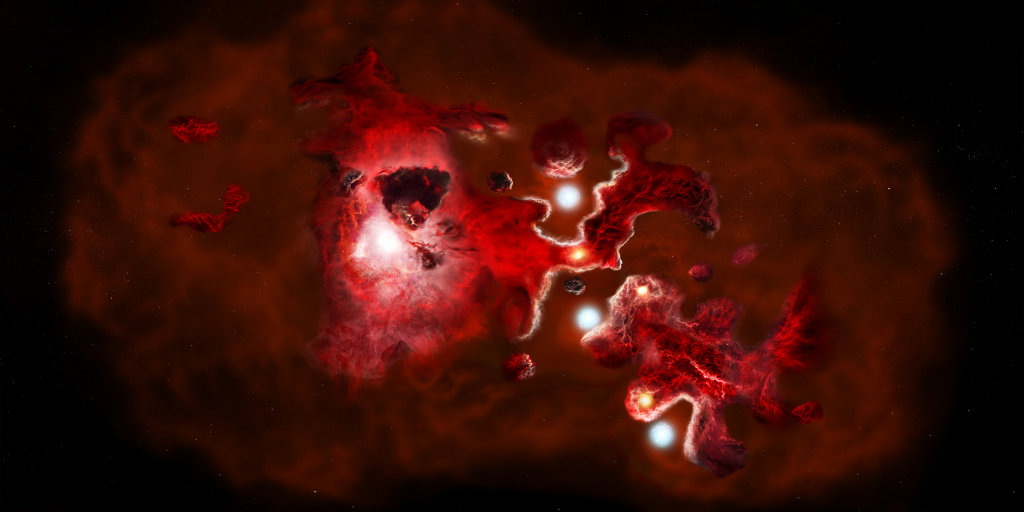
This artist’s impression of the formation of an early universe galaxy featuring clumps of star-forming galaxies, with carbon gas shown in red, and dark dust shown in black. This process is documented in detail throughout the many galaxies observed in ALMA’s CRISTAL survey. Credit: NSF/AUI/NSF NRAO/B. Saxton
Groundbreaking survey provides unprecedented views of galaxy formation when the Universe was just a toddler
Astronomers are getting a much clearer picture of what galaxies looked like in the early Universe, thanks to a large, comprehensive, and detailed study using the Atacama Large Millimeter/submillimeter Array (ALMA), of which the U.S. National Science Foundation National Radio Astronomy Observatory (NSF NRAO) is a partner. The [CII] Resolved ISM in STar-forming galaxies with ALMA (CRISTAL survey) peered back to when the Universe was only about one billion years old – a mere toddler in cosmic terms. These observations are helping scientists understand how galaxies formed and evolved from primordial gas clouds into the organized structures we see today.
“ALMA’s incredible ability to see through dust and gas has allowed us to observe these distant galaxies in remarkable detail,” explains Rodrigo Ignacio Herrera Camus, with Chile’s Universidad de Concepción. “We’re not just seeing blobs of light; we’re resolving the internal structures of these galaxies and learning about the processes happening within them.”
The CRISTAL survey focused on a sample of star-forming galaxies that showed the typical relationship between a galaxy’s mass and its star formation rate. ALMA’s observations of these galaxies revealed:
- Diverse Shapes and Motions: Some galaxies showed signs of orderly rotation, suggesting the formation of early disks. Others displayed chaotic motions and disturbed shapes, indicative of galaxies colliding and merging.
- Extended Gas Clouds: ALMA detected clouds of gas, revealed by their emission of a specific type of light from ionized carbon, extending far beyond the regions where stars formed. This suggested that galaxies are surrounded by vast gas reservoirs, potentially fueling future star formation or being expelled by powerful outflows.
- Clumpy Star Formation: Many galaxies exhibited star formation occurring in distinct clumps, providing insights into how stars are born in these early systems.
One particularly intriguing finding is the discovery of a galaxy, named CRISTAL-10, exhibiting an extreme deficit of ionized carbon emission relative to its far-infrared light, a ratio similar to that seen in Arp 220, one of the most luminous and obscured galaxies in the local Universe. Further study of this galaxy could reveal the interstellar medium’s power source and physical state in the early Universe.
“CRISTAL provides the kind of detailed data that simply wasn’t possible before ALMA,” adds Herrera Camus, “We’ve got a new family portrait of early galaxy evolution. These observations are challenging our existing models of galaxy formation and providing new avenues for research.”
The CRISTAL survey demonstrates the power of ALMA for studying galaxy evolution in the early Universe. By tracing the cold gas and dust that fuel star formation, ALMA is helping scientists piece together the story of how galaxies like our own Milky Way came to be.
About ALMA
The Atacama Large Millimeter/submillimeter Array (ALMA), an international astronomy facility, is a partnership of the European Southern Observatory (ESO), the U.S. National Science Foundation (NSF), and the National Institutes of Natural Sciences (NINS) of Japan in cooperation with the Republic of Chile. ALMA is funded by ESO on behalf of its Member States, by NSF in cooperation with the National Research Council of Canada (NRC) and the National Science and Technology Council (NSTC) in Taiwan and by NINS in cooperation with the Academia Sinica (AS) in Taiwan and the Korea Astronomy and Space Science Institute (KASI).
ALMA construction and operations are led by ESO on behalf of its Member States; by the National Radio Astronomy Observatory (NRAO), managed by Associated Universities, Inc. (AUI), on behalf of North America; and by the National Astronomical Observatory of Japan (NAOJ) on behalf of East Asia. The Joint ALMA Observatory (JAO) provides the unified leadership and management of the construction, commissioning, and operation of ALMA.
This news article was originally published on the NRAO website on July 1, 2025.


Recent News
Mission Patagonia Welcomes Its 2026 Nature Guardians
A small cohort of educators, scientists and environmental leaders will embark March 3-14 to the southern edge of the world for Mission Patagonia, an immersive outdoor environmental education experience designed to foster deep connection to place, people and planet.
AARO Releases Report on Unidentified Anomalous Phenomena (UAP)
The U.S. Department of Defense recently released 2025 UAP Workshop: Narrative Data, Infrastructures, and Analysis. The report details key findings from the workshop conducted at AUI headquarters in August of 2025.
OCEAN Kids ‘Nurdle Patrol’ Engages Students and Builds Environmental Knowledge
“OCEAN Kids: Nurdle Patrol” empowers children to fight plastic pollution by enrolling them in a playful, audio-led “Secret Agent” mission.