Carlstrom will present his talk: “What Do We Know About The Big Bang?” to the public on three dates, along with a recording that will be shared on the NSF NRAO’s YouTube channel.
Recent News
10 Questions: Desmond Wysenyuy
Meet Desmond Wysenyuy, program coordinator for the North American Regional Office of Astronomy for Development.
Cosmic Cocktail: Exotic Methanol Discovered in Planet-Building Zones
New results from the ALMA COMPASS Large Program (Complex Organic Molecules in Protostars with ALMA Spectral Surveys) show that young, still-forming stars are surrounded by a surprisingly sophisticated “chemical starter kit”, including organic molecules such as methanol that may one day enrich planets.
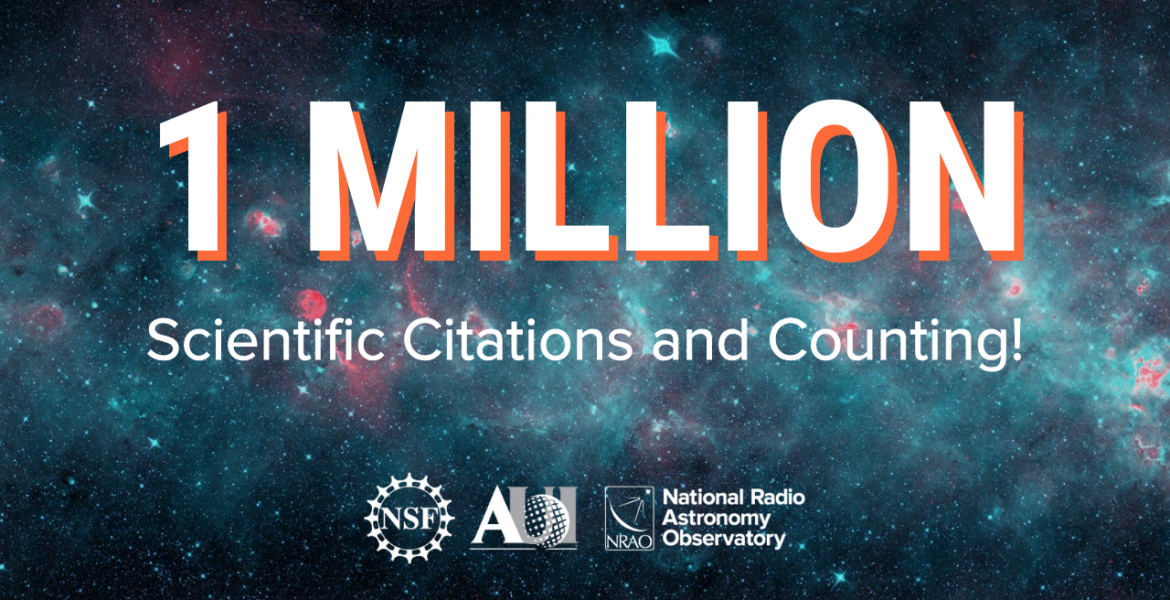
A Million Reasons to Celebrate: NSF NRAO Hits One Million Citations
Credit: NRAO/AUI/NSF
The U.S. National Science Foundation National Radio Astronomy Observatory (NSF NRAO) is celebrating a historic achievement: research using our telescopes has now been cited over one million times in scientific literature!
This remarkable milestone highlights the tremendous impact of our world-class facilities—including the Very Large Array (VLA), Very Long Baseline Array (VLBA),the Green Bank Telescope (GBT), and the Atacama Large Millimeter/submillimeter Array (ALMA). Together, these instruments have fueled groundbreaking discoveries and inspired generations of astronomers worldwide.
Highlights of this achievement:
- The VLA stands out as the most-cited NRAO instrument, with more than 561,000 citations.
- Of the Top 5 most-cited papers connected to NRAO, two are based on our instruments, two were authored by NRAO staff without instrument data, and one showcases key NRAO technology supporting a major space mission.
- The single most-cited NRAO instrument paper is the legendary NRAO VLA Sky Survey (Condon et al. 1998), with over 5,200 citations.
These numbers reflect not only decades of pioneering research, but also the dedication of engineers, staff, and scientists who keep these facilities at the forefront of exploration. From the earliest days of the NSF NRAO to today, every discovery has built toward this extraordinary accomplishment.
As we celebrate, we’re also looking ahead. The new generation of radio science—through projects like the Next Generation Very Large Array (ngVLA), the ALMA Wideband Sensitivity Upgrade, and advances in Next Generation Radar—will open fresh windows onto the Universe.
With more than a million citations behind us and countless discoveries ahead, NRAO remains committed to advancing humanity’s understanding of the cosmos.
Explore the milestone: NRAO Publications Statistics
This news article was originally published on the NRAO website on September 8, 2025.


Recent News
Professor John E. Carlstrom Delivers 2026 NSF NRAO Jansky Lectures
Carlstrom will present his talk: “What Do We Know About The Big Bang?” to the public on three dates, along with a recording that will be shared on the NSF NRAO’s YouTube channel.
10 Questions: Desmond Wysenyuy
Meet Desmond Wysenyuy, program coordinator for the North American Regional Office of Astronomy for Development.
Cosmic Cocktail: Exotic Methanol Discovered in Planet-Building Zones
New results from the ALMA COMPASS Large Program (Complex Organic Molecules in Protostars with ALMA Spectral Surveys) show that young, still-forming stars are surrounded by a surprisingly sophisticated “chemical starter kit”, including organic molecules such as methanol that may one day enrich planets.