
Astronomers using the Atacama Large Millimeter/submillimeter Array (ALMA) have captured the first direct, high-resolution images of a magnetic field wrapped tightly around the outflow of gas streaming away from a forming star — evidence that solves a decades-old puzzle about how young stars sculpt the powerful jets that form them.
Recent News
A Trillion Mile Cosmic Stream of Gas Feeds GW Orionis
A team of astronomers using the Atacama Large Millimeter/submillimeter Array (ALMA), of which the U.S. National Science Foundation National Radio Astronomy Observatory is a partner, has captured a massive stream of gas—one trillion miles, or .2 light years long—feeding the young triple-star system GW Orionis.
NSF NRAO radio observations help rule out a relativistic jet in rare stellar explosion
Astronomers studying a rare stellar explosion first spotted as a brief burst of X-rays used radio observations to help show that the dying star did not produce the powerful jet often associated with gamma-ray bursts.
ALMA Reveals Teenage Years of New Worlds
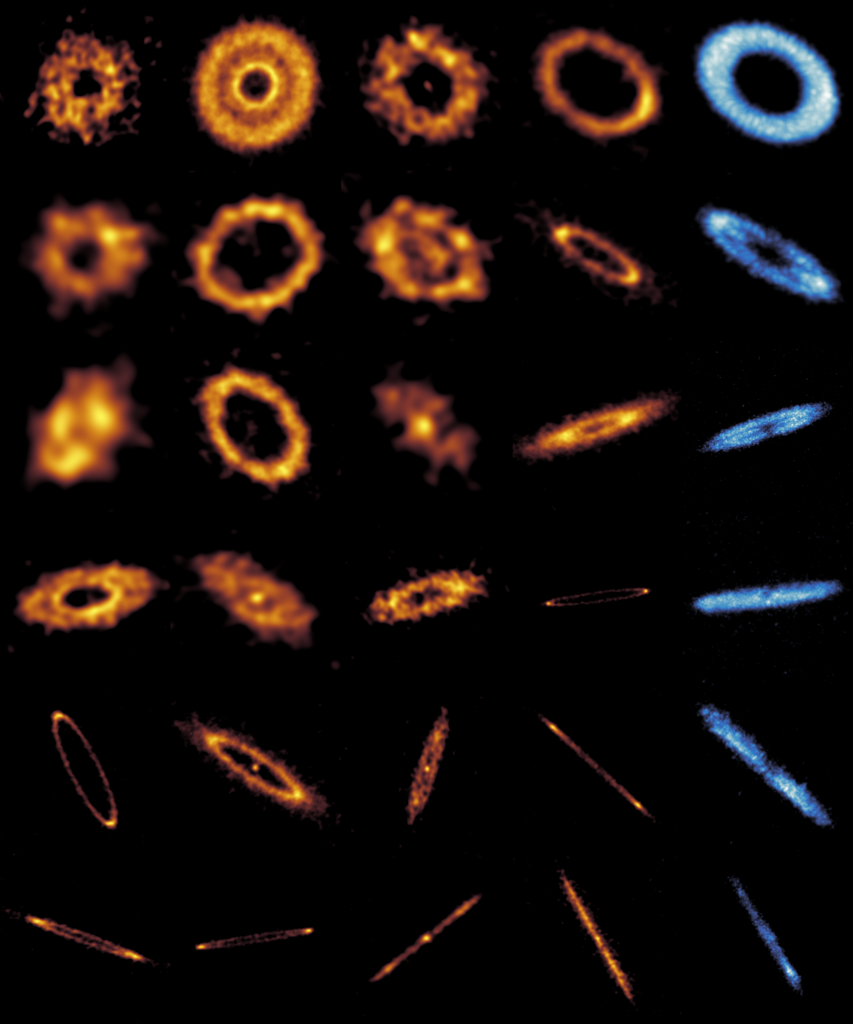
This ARKS gallery of faint debris disks reveals details about their shape: belts with multiple rings, wide smooth halos, sharp edges, and unexpected arcs and clumps, which hint at the presence of planets shaping these disks; and chemical make-up: the amber colors highlight the location and abundance of the dust in the 24 disks surveyed, while the blue their carbon monoxide gas location and abundance in the six gas-rich disks. Credit: Sebastian Marino, Sorcha Mac Manamon, and the ARKS collaboration
New astronomical survey captures previously unknown growing pains in the lives of planets
Astronomers have, for the first time, captured a detailed snapshot of planetary systems in an era long shrouded in mystery. The ALMA survey to Resolve exoKuiper belt Substructures (ARKS), using the Atacama Large Millimeter/submillimeter Array (ALMA), has produced the sharpest images ever of 24 debris disks, the dusty belts left after planets finish forming. These disks are the cosmic equivalent of the teenage years for planetary systems—somewhat more mature than newborn, planet-forming disks, but not yet settled into adulthood.
A Missing Link in Planetary Family Albums
“We’ve often seen the ‘baby pictures’ of planets forming, but until now, the ‘teenage years’ have been a missing link,” says Meredith Hughes, an Associate Professor of Astronomy at Wesleyan University and co-PI of this study.
Our own Solar System’s counterpart to this phase is the Kuiper Belt, a ring of icy debris beyond Neptune that preserves a record of massive collisions and planetary migrations from billions of years ago. By studying 24 exoplanetary debris belts, the ARKS team has opened a window into what our Solar System went through as the Moon was forming and as planets jostled for their final places, and sometimes trading orbits!
Teenage Disks: Hard to “Photograph,” Impossible to Ignore
Debris disks are faint, hundreds or even thousands of times dimmer than the bright, gas-rich disks where planets are born. The ARKS team overcame these challenges and produced images of these disks in unprecedented detail. Like teenagers dodging the camera, these faint disks have managed to hide from astronomers for years. But, thanks to ALMA, astronomers can now see their complex structures: belts with multiple rings, wide smooth halos, sharp edges, and even unexpected arcs and clumps.
“We’re seeing real diversity—not just simple rings, but multi-ringed belts, halos, and strong asymmetries, revealing a dynamic and violent chapter in planetary histories,” adds Sebastián Marino, program lead for ARKS, and an Associate Professor at the University of Exeter.
Highlights and Firsts from ARKS
- A New Benchmark: ARKS is the largest, highest-resolution survey of debris disks, akin to a ‘DSHARP-for-debris-disks’, setting a new gold standard.
- A Dynamic, Violent Youth: About one-third of observed disks show clear substructures (multiple rings or distinct gaps) suggesting legacy features left from earlier, planet-building stages or sculpted by planets over much longer timescales.
- Unexpected Diversity: While some disks inherit intricate structures from their earlier years, others mellow out and spread into broad belts, similar to how we expect the Solar System to have developed.
- Clues to Planetary ‘Stirring’: Many disks show evidence for zones of calm and chaos, with vertically “puffed-up” regions, akin to our Solar System’s own mix of serene classical Kuiper Belt objects and those scattered by Neptune’s long-ago migration.
- Surprising Gas Survivors: Several disks retain gas much longer than expected. In some systems, lingering gas may shape the chemistry of growing planets, or even push dust into wide halos.
- Asymmetries and Arcs: Many disks are lopsided, with bright arcs or eccentric shapes, hinting at gravitational shoves from unseen planets, leftover birth scars from planetary migration, or interactions between the gas and dust.
- Public Data Release: All ARKS observations and processed data are being made freely available to astronomers worldwide, enabling further discoveries.
Implications: Your Solar System Was Once a Wild Ride
The ARKS results show this teenage phase is a time of transition and turmoil. “These disks record a period when planetary orbits were being scrambled and huge impacts, like the one that forged Earth’s Moon, were shaping young solar systems,” says Luca Matrà, a co-PI on the survey, and Associate Professor at Trinity College Dublin.
By looking at dozens of disks around stars of different ages and types, ARKS helped decode whether chaotic features are inherited, sculpted by planets, or arise from other cosmic forces. Answering these questions could reveal whether our Solar System’s history was unique, or the norm.
Looking Ahead: Hunting for Planetary Architects
The ARKS survey’s findings are a treasure trove for astronomers hunting for young planets and seeking to understand how planet families, like our own, are built and rearranged.
“This project gives us a new lens for interpreting the craters on the Moon, the dynamics of the Kuiper Belt, and the growth of planets big and small. It’s like adding the missing pages to the Solar System’s family album,” adds Hughes.
The ARKS survey is the work of an international team of approximately 60 scientists, led by the University of Exeter, Trinity College Dublin, and Wesleyan University. For more information, visit https://arkslp.org/.
About ALMA
The Atacama Large Millimeter/submillimeter Array (ALMA), an international astronomy facility, is a partnership of the European Southern Observatory (ESO), the U.S. National Science Foundation (NSF) and the National Institutes of Natural Sciences (NINS) of Japan in cooperation with the Republic of Chile. ALMA is funded by ESO on behalf of its Member States, by NSF in cooperation with the National Research Council of Canada (NRC) and the National Science and Technology Council (NSTC) in Taiwan and by NINS in cooperation with the Academia Sinica (AS) in Taiwan and the Korea Astronomy and Space Science Institute (KASI).
ALMA construction and operations are led by ESO on behalf of its Member States; by the National Radio Astronomy Observatory (NRAO), managed by Associated Universities, Inc. (AUI), on behalf of North America; and by the National Astronomical Observatory of Japan (NAOJ) on behalf of East Asia. The Joint ALMA Observatory (JAO) provides the unified leadership and management of the construction, commissioning and operation of ALMA.
About NRAO
The National Radio Astronomy Observatory (NRAO) is a facility of the U.S. National Science Foundation, operated under cooperative agreement by Associated Universities, Inc.
This news article was originally published on the NRAO website on January 20, 2026.


Recent News
Twisted Physics: Astronomers Solve 30-Year-Old Stellar Mystery
Astronomers using the Atacama Large Millimeter/submillimeter Array (ALMA) have captured the first direct, high-resolution images of a magnetic field wrapped tightly around the outflow of gas streaming away from a forming star — evidence that solves a decades-old puzzle about how young stars sculpt the powerful jets that form them.
A Trillion Mile Cosmic Stream of Gas Feeds GW Orionis
A team of astronomers using the Atacama Large Millimeter/submillimeter Array (ALMA), of which the U.S. National Science Foundation National Radio Astronomy Observatory is a partner, has captured a massive stream of gas—one trillion miles, or .2 light years long—feeding the young triple-star system GW Orionis.
NSF NRAO radio observations help rule out a relativistic jet in rare stellar explosion
Astronomers studying a rare stellar explosion first spotted as a brief burst of X-rays used radio observations to help show that the dying star did not produce the powerful jet often associated with gamma-ray bursts.