
Astronomers using the Atacama Large Millimeter/submillimeter Array (ALMA) have captured the first direct, high-resolution images of a magnetic field wrapped tightly around the outflow of gas streaming away from a forming star — evidence that solves a decades-old puzzle about how young stars sculpt the powerful jets that form them.
Recent News
A Trillion Mile Cosmic Stream of Gas Feeds GW Orionis
A team of astronomers using the Atacama Large Millimeter/submillimeter Array (ALMA), of which the U.S. National Science Foundation National Radio Astronomy Observatory is a partner, has captured a massive stream of gas—one trillion miles, or .2 light years long—feeding the young triple-star system GW Orionis.
NSF NRAO radio observations help rule out a relativistic jet in rare stellar explosion
Astronomers studying a rare stellar explosion first spotted as a brief burst of X-rays used radio observations to help show that the dying star did not produce the powerful jet often associated with gamma-ray bursts.
Northwest Indian College Hosts Inaugural Cosmovisions of the Pacific Meeting
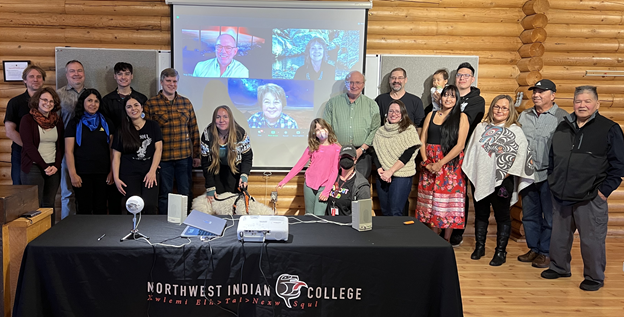
Bellingham, Washington – Over 14,000 years ago, Indigenous groups in the Pacific traveled by boat, guided by starlight, and likely settled the West Coast of the Americas. Today, Indigenous and non-indigenous people gathered at Northwest Indian College (NWIC) to explore similarities and differences between Indigenous ways of knowing and non-indigenous science practices in astronomyelated disciplines. In this first gathering of the Cosmovisions of the Pacific, participants enjoyed cultural presentations, engaged in hypothetical scenarios, and discussed differences and similarities in approaches, areas of potential collaborations, and ideas for future projects.
Cosmovisions, or worldview, is an appropriate name for a partnership that seeks to cultivate culturally responsive collaboration for the awareness and advancement of Indigenous ways of knowing, and astronomy-related education and research in the 21st century. This partnership is composed of the Indigenous Education Institute (IEI), the Imiloa Astronomy Center of Hawaii’, AUI, and made possible by funding through the Heising-Simons Foundation.
“Cosmovisions of the Pacific has helped me to understand how other Indigenous and non-indigenous see, connect, and interpreted what is around us,” said AUI’s Senior STEM Education Specialist, Yasmin Catricheo. “As an Indigenous woman that works in science and education, being able to understand how others connect with the universe and with each other is crucial when it comes to finding ways of cooperation to build a strong and inclusive future for all ways of knowing.”
Together, the group will develop a whitepaper based on the findings of today’s event, identifying key areas of future collaborative research between Indigenous and non-indigenous investigators and practitioners, as well as a protocol for implementation of collaborative research based on principles of “Collaboration with Integrity”, developed through the work of IEI. The whitepaper will lay the foundation for phase 2 of the Cosmovisions of the Pacific gathering of 150 Indigenous and non-indigenous persons.
More Information
AUI is an independent, non-profit corporation founded in 1946 that specializes in designing, building, and managing cutting-edge research facilities and the development and implementation of innovative approaches to education, outreach, and workforce development. Currently, AUI manages two U.S.-funded research and development centers: The National Radio Astronomy Observatory (NRAO) and the Green Bank Observatory (GBO). NRAO is the North American partner in the management of the Atacama Large Millimeter/submillimeter Array (ALMA) in Chile. In addition, NRAO includes the Very Large Array (VLA), and the Very Long Baseline Array (VLBA), and GBO is home to the 100-meter Green Bank Telescope.
Media Contact: Matt Schaub
[email protected]


Recent News
Twisted Physics: Astronomers Solve 30-Year-Old Stellar Mystery
Astronomers using the Atacama Large Millimeter/submillimeter Array (ALMA) have captured the first direct, high-resolution images of a magnetic field wrapped tightly around the outflow of gas streaming away from a forming star — evidence that solves a decades-old puzzle about how young stars sculpt the powerful jets that form them.
A Trillion Mile Cosmic Stream of Gas Feeds GW Orionis
A team of astronomers using the Atacama Large Millimeter/submillimeter Array (ALMA), of which the U.S. National Science Foundation National Radio Astronomy Observatory is a partner, has captured a massive stream of gas—one trillion miles, or .2 light years long—feeding the young triple-star system GW Orionis.
NSF NRAO radio observations help rule out a relativistic jet in rare stellar explosion
Astronomers studying a rare stellar explosion first spotted as a brief burst of X-rays used radio observations to help show that the dying star did not produce the powerful jet often associated with gamma-ray bursts.