
A team of astronomers using the Atacama Large Millimeter/submillimeter Array (ALMA), of which the U.S. National Science Foundation National Radio Astronomy Observatory is a partner, has captured a massive stream of gas—one trillion miles, or .2 light years long—feeding the young triple-star system GW Orionis.
Recent News
NSF NRAO radio observations help rule out a relativistic jet in rare stellar explosion
Astronomers studying a rare stellar explosion first spotted as a brief burst of X-rays used radio observations to help show that the dying star did not produce the powerful jet often associated with gamma-ray bursts.
10 Questions: Mario Vargas
Meet Mario Vargas, a technical specialist III at the U.S. National Science Foundation National Radio Astronomy Observatory’s Central Development Laboratory.
West Virginia Students Contact International Space Station LIVE
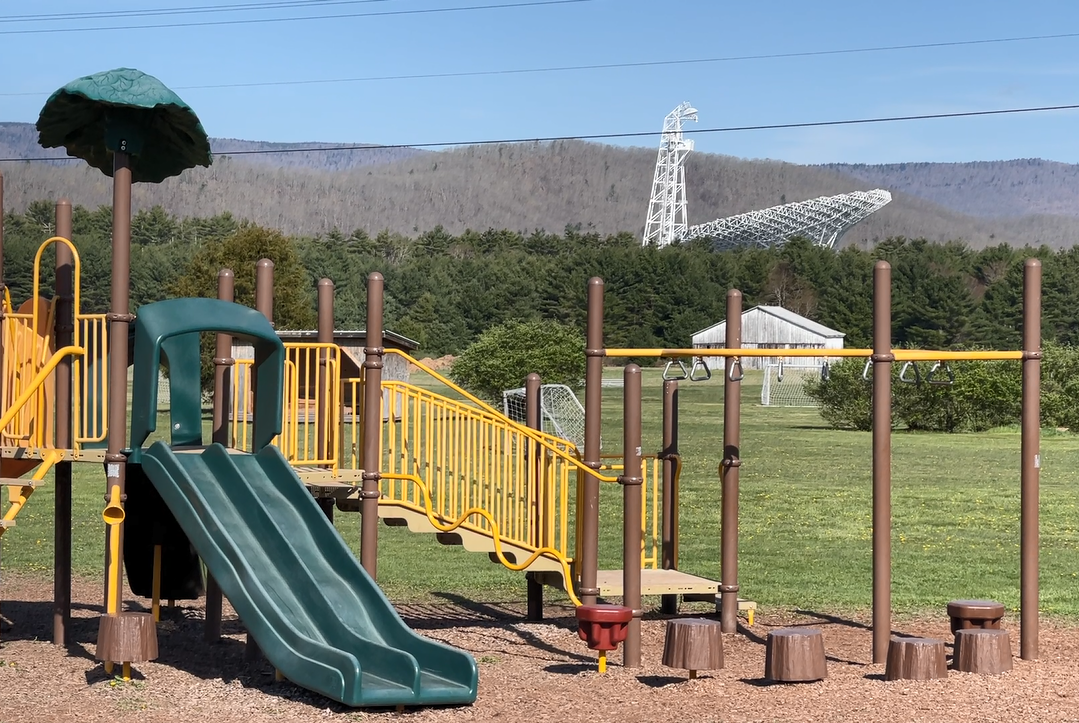
How would you feel if you could talk to an astronaut, orbiting over 200-miles above you in space?
Friday, May 7th at 8:00 AM EDT, students in rural West Virginia will experience this once in a lifetime opportunity. Green Bank Elementary-Middle School (GBEMS) will be contacting astronaut Mark Vande Hei on the International Space Station (ISS).
This contact is made possible by Amateur Radio on the International Space Station (ARISS), an international program that inspires students to pursue careers in science, technology, engineering and math. This experience is a limited opportunity available to only a handful of schools – around the world – who must go through an extensive application process, working closely with staff and volunteers to assemble the resources required.
GBEMS is located in secluded and mountainous Pocahontas County, West Virginia, one of the largest counties with one of the smallest populations east of the Mississippi River. The school happens to be next door to the Green Bank Observatory, home of the largest fully steerable radio telescope in the world, an unusual and impressive playground backdrop. Several staff from the Observatory volunteered to support this project, helping students to select and install the technology for this radio contact. The students only have a few precious minutes to establish a connection as the space station orbits above them on Earth.
School principal Julie Shiflet and science teacher Anne Smith put in many hours with students, staff, and volunteers to make this project possible. Following COVID-19 safety guidelines, a small group of students and staff will be using special radio equipment set up in the school gym for this contact. This event will be livestreamed from the Observatory Facebook page for the public to share in the excitement.
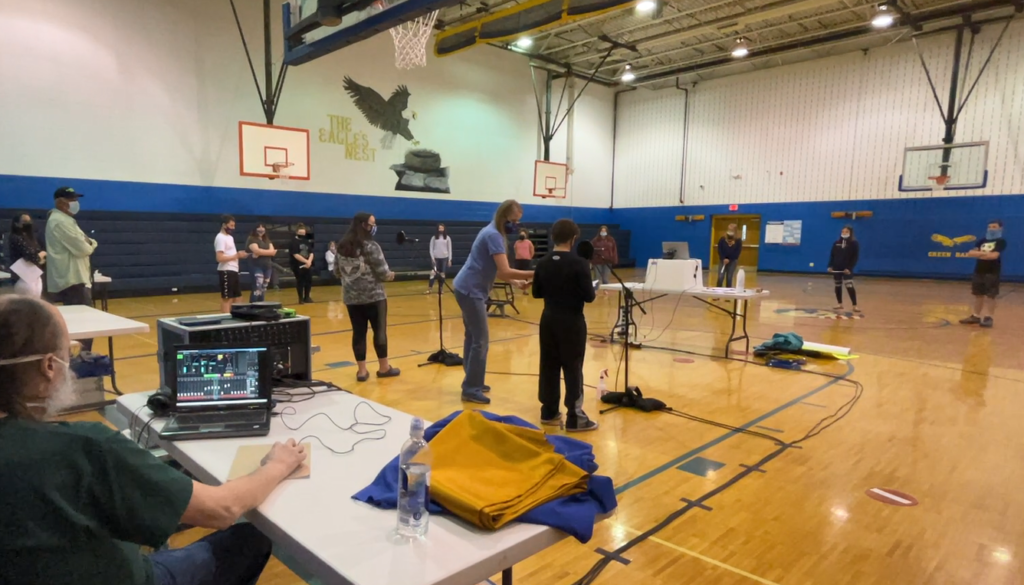
Students, staff, and volunteers rehearsing for the contact. A variety of connections must be tested, and the program timed, to ensure contact with the International Space Station as it passes overhead. Photo credit NSF/GBO/Jill Malusky.
The generosity of several groups made this project possible, including the Snowshoe Foundation, The Durbin Lions Club, the Eight Rivers Amateur Radio Club, and the Green Bank Observatory, with special thanks to GBEMS Principal Julie Shiflet and Science Teacher Anne Smith.
To learn more about Green Bank Observatory Observatory science and to see research opportunities visit their website. The Green Bank Observatory is a facility of the National Science Foundation and is operated by Associated Universities, Inc.
###
This news article was originally published on the GBO website on April 28, 2021.


Recent News
A Trillion Mile Cosmic Stream of Gas Feeds GW Orionis
A team of astronomers using the Atacama Large Millimeter/submillimeter Array (ALMA), of which the U.S. National Science Foundation National Radio Astronomy Observatory is a partner, has captured a massive stream of gas—one trillion miles, or .2 light years long—feeding the young triple-star system GW Orionis.
NSF NRAO radio observations help rule out a relativistic jet in rare stellar explosion
Astronomers studying a rare stellar explosion first spotted as a brief burst of X-rays used radio observations to help show that the dying star did not produce the powerful jet often associated with gamma-ray bursts.
10 Questions: Mario Vargas
Meet Mario Vargas, a technical specialist III at the U.S. National Science Foundation National Radio Astronomy Observatory’s Central Development Laboratory.